Heating Tax Credits in 2026: What Is Left
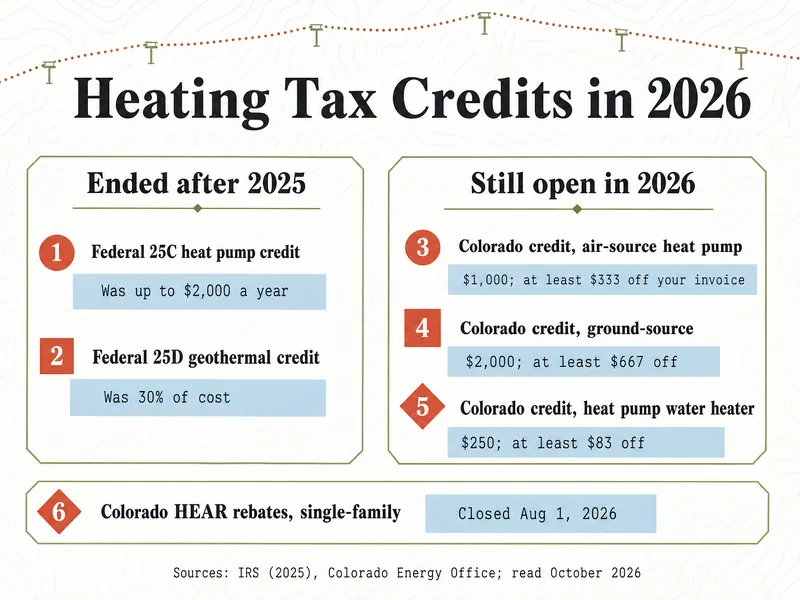
Heating tax credits in 2026 come down to one: the federal 25C and 25D credits ended after December 31, 2025, while Colorado's $1,000 air-source heat pump credit continues; your contractor claims it and must pass at least $333 to you on the invoice.
Written by the Upvalley Heat desk from manuals and official pages · how figures are sourced · Rechecked
First tracks
- Federal 25C stopped at the end of 2025 for anything put into use later, and 25D stopped for money spent on work finished later, per the IRS FAQ on Public Law 119-21 (2025).
- Paying in 2025 for a geothermal system finished in 2026 does not keep the 25D credit: the IRS treats the expenditure as made when installation is completed.
- Colorado's heat pump tax credit for installs from January 1, 2026 is $1,000 for air-source, $2,000 for ground-source and $250 for a heat pump water heater, per the Colorado Energy Office.
- A registered contractor claims the Colorado credit and must pass at least 33% of it to you as a discount; you file nothing.
- Colorado's single-family HEAR rebates took applications from November 13, 2025 to August 1, 2026 and are closed.
- LEAP heating-bill help opens for the 2026–27 season on November 1, 2026, per CDHS.
If you are pricing a heat pump, furnace or boiler for a home in Glenwood Springs, Basalt or Aspen this winter, the federal tax credits that shaped quotes from 2023 through 2025 are gone. What remains is a smaller Colorado credit that never touches your tax return, utility rebates, and help for lower-income households. Programs change; check before you buy.
Which heating tax credits ended after 2025?
Both federal home energy credits ended. Public Law 119-21, signed July 4, 2025, closed the Energy Efficient Home Improvement Credit (25C) for any property placed in service after December 31, 2025 and the Residential Clean Energy Credit (25D) for any expenditure made after that date, according to the IRS's August 2025 FAQ. The IRS 25C page, updated April 2026, now says you can claim it for improvements made "through December 31, 2025".
That covers every heating item people used to claim: heat pumps, central air conditioners, gas furnaces and boilers, heat pump water heaters, electric panel upgrades, home energy audits and geothermal heat pumps. Some older IRS FAQ pages still show the earlier 2033 and 2034 end dates; the newer FAQ and the credit pages replace them.
Heating tax credits, 2025 and 2026
- $2,000Yearly 25C cap for heat pumps through 2025 (now ended)IRS, 25C page
- 30%25D credit for geothermal heat pumps through 2025 (now ended)IRS, 25D page
- $1,000Colorado credit per air-source heat pump installed in 2026Colorado Energy Office
- $333Smallest invoice discount on that $1,000 creditColorado Energy Office
What did the federal heating tax credits pay through 2025?
Through 2025, 25C paid 30% of qualified costs with two annual limits: up to $2,000 a year for heat pumps, heat pump water heaters and biomass stoves or boilers, and a separate $1,200 a year for everything else. Inside the $1,200, gas furnaces, boilers, central air conditioners and 200-amp-plus panels were capped at $600 per item and a home energy audit at $150. Heat pumps had to meet the CEE highest non-advanced tier, and 2025 claims needed a Qualified Manufacturer Identification Number for each item.
25D paid 30% of the cost of a geothermal heat pump with no annual limit, provided it met ENERGY STAR, per the IRS 25D page. Both credits were nonrefundable. If you installed qualifying equipment in 2025 and did not claim it, the IRS says an amended return is generally due within 3 years of filing or 2 years of paying the tax, whichever is later.
| Credit or rebate | Paid through 2025 | Status for 2026 installs |
|---|---|---|
| Federal 25C (heat pumps, heat pump water heaters) | 30%, up to $2,000 a year | Ended after December 31, 2025 |
| Federal 25C (furnaces, boilers, central AC) | 30%, up to $600 per item within $1,200 | Ended after December 31, 2025 |
| Federal 25D (geothermal heat pumps) | 30%, no annual cap | Ended after December 31, 2025 |
| Colorado credit, air-source heat pump | $1,500 (2024–2025) | $1,000, at least $333 to the buyer |
| Colorado credit, ground-source heat pump | $3,000 (2024–2025) | $2,000, at least $667 to the buyer |
| Colorado credit, heat pump water heater | $500 (2024–2025) | $250, at least $83 to the buyer |
| Colorado HEAR rebates, single-family | Opened November 13, 2025 | Closed August 1, 2026 |
How does Colorado's heat pump tax credit work in 2026?
Colorado's credit still exists in 2026, but your contractor claims it, not you. A contractor registered with the Colorado Energy Office claims $1,000 for an air-source heat pump, $2,000 for a ground-, water- or combined-source heat pump, or $250 for a heat pump water heater, and must give you at least 33% of it as a line on the invoice labeled "State of Colorado Heat Pump Discount". The state's heat pump tax credit page says customers "do not need to file any paperwork".
The equipment must be ENERGY STAR certified; air-source systems must be AHRI-matched, and space-heating heat pumps must be designed to meet at least 80% of the home's annual heating needs. A bill to end the credit after 2025, HB25B-1018, died in committee in August 2025, and HB26-1289, signed June 3, 2026, removed a possible 50% cut. Amounts drop again in tax year 2029, and December 31, 2026 is the last day a contractor can register to claim 2026 installs, so ask early whether yours is registered. The cold-climate heat pump notes cover what a mountain-ready unit looks like.
Colorado's separate 10% heat pump income tax credit and its state sales tax exemption for heat pumps both expired December 31, 2023, per the Colorado Department of Revenue's DR 1322 form.
What happened to the Colorado HEAR rebates?
The single-family Home Electrification and Appliance Rebates (HEAR) are closed. The Colorado Energy Office's home energy rebates page, updated October 2026, says it accepted applications from November 13, 2025 to August 1, 2026 and that the program is "no longer available". While open, it paid income-qualified households through registered contractors, up to $8,000 for a cold-climate mini-split, and it excluded secondary and vacation homes, which ruled out many houses in Aspen and Snowmass Village.
The other federal rebate tracks are listed as "Coming Soon": HEAR for small multifamily buildings and the Home Efficiency Rebates (HER, also called HOMES) for manufactured and mobile homes and for multifamily buildings of 50,000 sq ft or more. None of them offers anything for an ordinary single-family house today.
Can a 2025 payment save a 2026 heating tax credit?
No. The IRS FAQ answers this directly for 25D: an expenditure counts as made when original installation is completed, so a geothermal system finished after December 31, 2025 earns no credit even if the deposit or the full price was paid in 2025. For 25C, the test is the date the property was placed in service, and nothing placed in service after 2025 qualifies.
The practical step is to check your 2025 return. If the equipment was installed and running by December 31, 2025, the credit belongs on that return, with the QMID for each 25C item. If the work finished in January 2026 or later, look at the Colorado credit and utility heating rebates instead.
Where can lower-income homes get help?
Several programs remain for households that qualify by income:
- LEAP, Colorado's heating-bill help, takes 2026–27 applications from November 1, 2026 through April 30 through Colorado PEAK or your county human services office; CDHS says it usually pays $200 to $1,000, once a season.
- Weatherization Assistance is free and serves Pitkin, Garfield and Eagle counties through Northwest Colorado Council of Governments; renters can apply, homes weatherized in the past 15 years cannot, and air-source heat pumps are offered "on a limited basis", per the Colorado Energy Office.
- Holy Cross Energy doubles its rebates for members under 150% of area median income, for example $7,000 instead of $3,500 for a heat pump.
- ReEnergize Garfield County, run by CLEER, gives a free assessment and $500 in installed upgrades to households at or below 150% of area median income.
The 2026 rebates overview shows how these fit with REMP fees and permits.
Avalanche report: how this page was checked
This page draws on the IRS's August 2025 FAQ on Public Law 119-21 (FS-2025-05), the IRS 25C page (updated April 2026), the IRS 25D page (updated July 2026), the Colorado Energy Office's heat pump tax credit, home energy rebates and weatherization pages (October 2026), the Colorado legislature's pages for HB25B-1018 and HB26-1289, the Department of Revenue's 2024 DR 1322 form and CDHS's LEAP page. Everything was read in October 2026; the IRS and state energy office pages got a second look on October 27, 2026, with no changes found. Left out: tax advice for your own return, local sales tax rules (not researched), and any program the state no longer lists.
Lift-line questions
Can you still claim 25C for a furnace installed in December 2025?
Yes, if it was placed in service by December 31, 2025; the IRS wording bars only property placed in service after that date. The furnace limit was $600 within the $1,200 annual cap, and 2025 claims needed the item's QMID.
Does the Colorado heat pump credit show up on your state tax return?
No. The registered contractor claims it on its own return and gives you at least a third as an invoice discount. The Department of Revenue's form says a building owner cannot claim it unless the owner is a registered contractor who installed the heat pump.
How do you know a contractor is registered for the Colorado credit?
The Colorado Energy Office publishes a list of registered contractors on its heat pump tax credit page. Ask to see the "State of Colorado Heat Pump Discount" line on the quote before you sign.
Does a mini-split in a second home qualify for the Colorado credit?
The state's page says the credit applies to "Colorado residents, businesses, and other organizations" that install through a registered contractor; it does not address second homes directly. Ask the registered contractor how it handles your case. The unit must be ENERGY STAR certified, AHRI-matched and, for space heating, designed for at least 80% of annual heating needs.
Is there a Colorado sales tax break on heat pumps in 2026?
Not at the state level. The state sales tax exemption for heat pumps expired December 31, 2023. Local sales tax rules were not researched for this page.
When will Colorado's HOMES rebates open for single-family houses?
The Colorado Energy Office lists no HOMES (HER) offer for ordinary single-family houses. Its HER tracks cover manufactured and mobile homes and multifamily buildings of 50,000 sq ft or more, and both show "Coming Soon".
Will the Colorado heat pump credit shrink again?
Yes, the Colorado Energy Office says amounts decrease again in tax year 2029. For 2026 through 2028 the air-source amount is $1,000.
Next runs



Back to the base lodge: heating and cooling notes for the whole valley