Heat Pump Refrigerant and Efficiency Rules
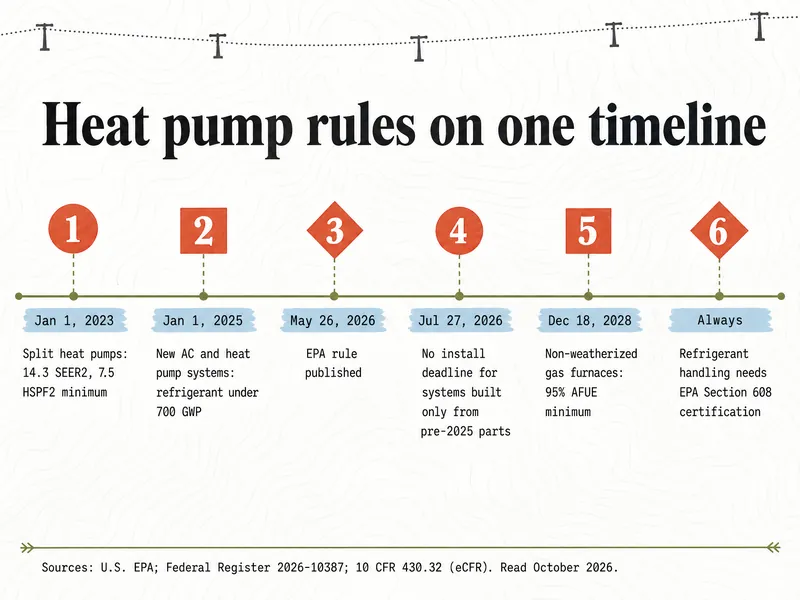
Refrigerant rules changed in 2025: new home heat pumps and air conditioners must use refrigerant under 700 GWP, such as R-454B or R-32, though a 2026 EPA rule still allows some R-410A installs.
Written by the Upvalley Heat desk from manuals and official pages · how figures are sourced · Rechecked
Ownership note: Upvalley Heat belongs to the same ownership group as PlumbingSupplyAndMore, Central Plumbing & HVAC, SoftPro Water Systems and Quality Water Treatment, the businesses this page links to. Figures here come from federal, Colorado, county and utility pages and from manufacturers' installation manuals, read in October 2026. What a store says about its own products is the store's claim, not a finding of this site. How partner links work here
First tracks
- New home AC and heat pump systems need refrigerant under 700 GWP for components made from January 1, 2025 (EPA sector table).
- An EPA rule published May 26, 2026 and effective July 27, 2026 removed the installation deadline for systems built only from parts made or imported before 2025.
- EPA says a new R-454B or R-32 outdoor unit cannot be paired with an indoor coil not designed for it, such as an old R-410A coil.
- Federal minimums for split heat pumps made since January 1, 2023 are 14.3 SEER2 and 7.5 HSPF2; Colorado uses the national figures (10 CFR 430.32).
- Non-weatherized gas furnaces made from December 18, 2028 must reach 95% AFUE; a petition to delay that was published April 27, 2026 with no final action as of October 2026.
- Only EPA Section 608 certified technicians may buy refrigerant for home AC and heat pump systems.
The refrigerant and efficiency rules come from Washington, not the town hall, so they apply the same way in Glenwood Springs and Aspen. What changes up here is the setting: long heating seasons that make HSPF2 matter, and an elevation that even shows up in the installation tables for the new refrigerants.
What changed in heat pump refrigerant rules?
Since January 1, 2025, new residential air conditioning and heat pump systems, including mini-splits, must use a refrigerant with a global warming potential (GWP) under 700. That is EPA's limit under the AIM Act's technology transitions program, shown in its restrictions-by-sector table (last updated August 2026).
The limit applies to new systems, not to the equipment already on your wall. EPA's homeowner questions say you can replace a faulty part of an existing R-410A system, such as a condensing unit or an indoor coil, with a similar R-410A part. Replacing both the condensing unit and the indoor coil together counts as installing a new system.
| Refrigerant | Safety class | New systems | Repairs and service |
|---|---|---|---|
| R-410A | Not an A2L; over the limit for new systems | Only if every specified part was made or imported before Jan 1, 2025 | Allowed with similar R-410A parts |
| R-454B | A2L: low toxicity, low flammability | Allowed; Bosch's IDS Ultra uses it | Top up only with R-454B, per Bosch |
| R-32 (HFC-32) | A2L: named by EPA as mildly flammable | Allowed | Only in equipment designed for it |
| Mixed system | – | A new A2L outdoor unit on an old R-410A coil is not allowed | No retrofitting R-410A systems to A2L |
What are A2L refrigerants like R-454B and R-32?
A2L is a safety class for refrigerants with low toxicity and low flammability, and R-454B and R-32 are the A2L types found in new home systems. Bosch's A2L refrigerant change notes explain the class and say products using different refrigerants cannot be mixed and matched, and that existing R-410A systems may not be retrofitted. EPA cites ASHRAE Standard 34 as the source of the classes.
Because they are mildly flammable, A2L systems carry rules that R-410A never needed. EPA's SNAP program and industry standards bar using R-32 or R-454B in equipment not designed for it. Bosch's R-454B heat pump FAQ says its units must be charged with R-454B only.
Elevation enters here. A2L installation manuals set a minimum room floor area for a given refrigerant charge, and Bosch's IDS Ultra installation manual (July 2026) raises that minimum with altitude. In its table, a 10 lb charge needs about 301 sq ft at 1,970–2,625 feet but about 348 sq ft at 5,908–6,562 feet, the band that takes in Carbondale (6,175 feet, USGS elevation at the town's map point). The installer checks the table for your elevation.
Can R-410A systems still be installed in 2026?
Yes, in one case: when every specified component of the system was made or imported before January 1, 2025. EPA's earlier rule had set January 1, 2026 as the last day to install such systems. A final rule published in the Federal Register on May 26, 2026, effective July 27, 2026, removed that deadline for the residential and light commercial AC and heat pump subsector.
Some pages written before the 2026 rule, including parts of EPA's own homeowner FAQ and some maker pages, still describe the old 2026 cutoff; the sector table and the Federal Register rule are the current text. A June 2026 court challenge by industry groups targets supermarket and remote condensing unit provisions, not home systems.
R-410A condensing units imported after January 1, 2025 may be used only to repair existing systems and must be labeled "for servicing existing equipment only." If a quote offers R-410A equipment, ask for the manufacture dates of each part and how long the maker expects to supply matching parts and refrigerant.

What do SEER2 and HSPF2 mean?
SEER2 rates seasonal cooling efficiency and HSPF2 rates seasonal heating efficiency; for both, higher numbers mean less electricity for the same comfort. The "2" marks the ratings used for federal minimums on equipment made from January 1, 2023, under 10 CFR 430.32. Older SEER and HSPF numbers are not directly comparable.
For a valley home, HSPF2 deserves more attention than SEER2, since the Aspen 1SW station logs about 8,880 heating degree days a year (NOAA, 1991–2020). HSPF2 is still a seasonal average, though; it does not tell you how a unit performs at 5°F. For that, see the COP figures in cold-climate heat pumps.
What efficiency rules apply in Colorado?
Colorado uses the national minimums because it is in neither DOE's southeast nor southwest region. For equipment made since January 1, 2023, that means 14.3 SEER2 and 7.5 HSPF2 for split heat pumps, 13.4 SEER2 for split air conditioners under 45,000 Btu/h, and 13.4 SEER2 and 6.7 HSPF2 for single-package heat pumps. An outdoor unit with any certified combination below a region's standard cannot be installed in that region.
Incentives ask for more. The Colorado heat pump tax credit requires ENERGY STAR certified, AHRI-matched systems, and ENERGY STAR's base split-system bar is 7.8 HSPF2, 15.2 SEER2 and 11.0 EER2. Local codes add their own twist: the 2021 Aspen Energy Code says split-system cooling on a forced-air system must be a heat pump sized to provide primary heat.
Rule numbers for 2026
- 700 GWPRefrigerant limit for new home AC and heat pump systems from Jan 1, 2025U.S. EPA
- 14.3 / 7.5Minimum SEER2 / HSPF2 for split heat pumps made from 2023 oneCFR, 10 CFR 430.32
- 95%AFUE floor for non-weatherized gas furnaces made from Dec 18, 2028eCFR, 10 CFR 430.32
- Jul 27, 2026Effective date of the EPA rule that ended the R-410A install deadline for pre-2025 partsFederal Register
What does the 2028 furnace efficiency rule change?
From December 18, 2028, new non-weatherized gas furnaces and mobile home gas furnaces must reach at least 95% AFUE, up from 80% today. DOE adopted the standard in a rule published December 18, 2023, effective February 16, 2024. It applies to furnaces made from that date, not to furnaces already in homes.
The date may still move. Gas industry groups petitioned DOE to push compliance to January 1, 2030 at the earliest, and DOE published the petition for comment on April 27, 2026. No final action changing the date had been published as of October 2026. For a dual fuel system, the rule shapes which furnaces will be on the market later; see backup heat and dual fuel, and for gas settings at elevation, furnace altitude derating.
Who may handle refrigerant and line sets?
Refrigerant work is for certified technicians only. EPA requires anyone who maintains, services, repairs or disposes of equipment that could release refrigerant to hold Section 608 certification; Type II covers high-pressure appliances such as home ACs and heat pumps. Under EPA's sales restriction, only 608-certified technicians can buy refrigerant for stationary AC, including non-ozone-depleting substitutes. Existing certifications stay valid under the new HFC rules.
Line sets, the insulated copper pair between indoor and outdoor units, are installer work too, because connecting them opens the refrigerant circuit. PlumbingSupplyAndMore's line sets and covers (part of Upvalley Heat's ownership group) show what these parts look like. Never open a refrigerant connection or add refrigerant yourself; if you are unsure, stop and call a qualified technician.
Avalanche report: how this page was checked
Sources: EPA's HFC restrictions-by-sector table (updated August 2026) and homeowner FAQ (updated September 2026), the Federal Register rules of December 26, 2023, December 18, 2023 and May 26, 2026, DOE's April 27, 2026 petition notice, the industry petition for review filed June 25, 2026, 10 CFR 430.32 on eCFR, EPA's Section 608 pages, ENERGY STAR's heat pump criteria, the Colorado Energy Office credit page, the 2021 Aspen Energy Code, and Bosch's A2L notes, R-454B FAQ and IDS Ultra manual, all read October 2026. Left out: refrigerant prices and supply forecasts, which no primary source gave, and any claim that the 2028 furnace date has been delayed.
Lift-line questions
Will my R-410A heat pump become illegal to use?
No. The rules cover new systems, not running equipment. EPA says an existing R-410A system can be repaired, including with a similar R-410A condensing unit or coil, by a certified technician.
Can my old R-410A indoor coil stay when the outdoor unit is replaced with R-454B?
No. EPA says mildly flammable refrigerants such as R-454B and R-32 cannot be used in systems not designed for them, and Bosch says R-410A systems may not be retrofitted. A new A2L outdoor unit needs a matched A2L indoor unit.
Are A2L refrigerants safe in a bedroom?
They are classed as low toxicity and low flammability, and the installation manuals control where they go. Those manuals set a minimum room area for the charge, and Bosch's tables raise that minimum at higher elevations. The installer checks this for each room.
Does the 2028 furnace rule mean my 80% furnace must be replaced?
No. The 95% AFUE minimum applies to non-weatherized gas furnaces made from December 18, 2028. Furnaces already installed can keep running, and a petition to delay the date was still pending in October 2026.
Is SEER2 15 better than SEER 15?
They are not the same scale. SEER2 and HSPF2 are the ratings that federal minimums have used from 2023 on, so compare SEER2 with SEER2 on every quote, and HSPF2 with HSPF2.
Can a homeowner buy refrigerant to top up a heat pump?
EPA restricts sales of refrigerant for stationary air conditioning to Section 608 certified technicians. A system that needs refrigerant has a leak, which needs a technician to find and fix it.
Does a new heat pump in Aspen need a permit?
The City of Aspen lists new or altered heating and cooling equipment as needing a mechanical permit. Elsewhere in the valley, expect a permit and ask the building department; tax-credit and rebate paperwork often asks for it too.
Runs from here

Back to the base lodge: Roaring Fork Valley heating, town by town