Radiant Floor Heating in Mountain Homes
Radiant floor heating warms a room by running warm water through tubing in the floor; REHAU's design manual caps the surface at 85°F in occupied rooms, so the water stays warm rather than hot.
Written by the Upvalley Heat desk from manuals and official pages · how figures are sourced · Rechecked
Ownership note: Upvalley Heat belongs to the same ownership group as PlumbingSupplyAndMore, Central Plumbing & HVAC, SoftPro Water Systems and Quality Water Treatment, the businesses this page links to. Figures here come from federal, Colorado, county and utility pages and from manufacturers' installation manuals, read in October 2026. What a store says about its own products is the store's claim, not a finding of this site. How partner links work here
First tracks
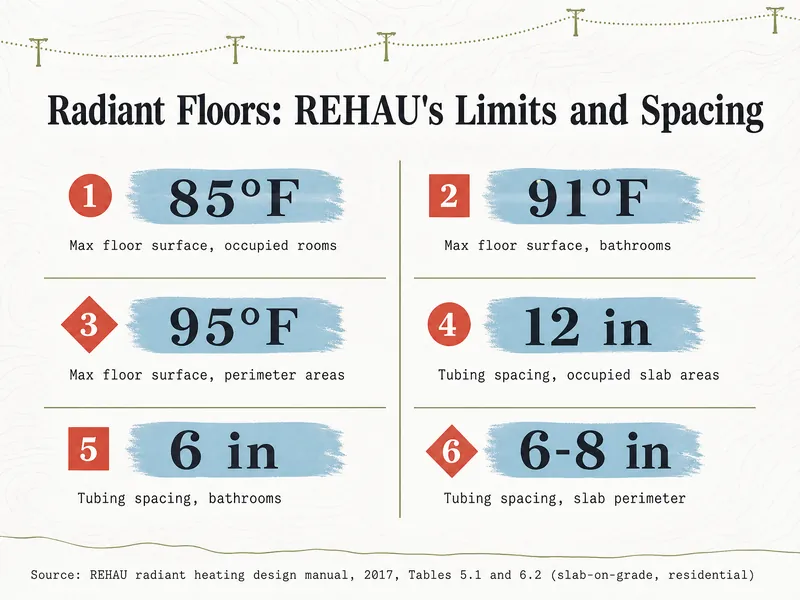
- REHAU's radiant heating design manual (2017) lists 85°F as the typical top floor-surface temperature in occupied rooms, 91°F in bathrooms and 95°F at the perimeter.
- In a residential slab on grade, REHAU spaces tubing about 12 inches apart in living areas, 6 inches in bathrooms and 6–8 inches along cold outside walls.
- A water-to-water ground-source heat pump typically makes water as warm as 120°F, which REHAU says meets the needs of many radiant floors.
- An older non-condensing boiler needs a mixing control so its return water stays above 140°F (REHAU); a condensing boiler is built to take cool return water.
- Without proper insulation, REHAU says downward and edge losses from a radiant panel can reach 50%; with recommended insulation they can fall to about 10%.
- Holy Cross Energy's 2026 heat pump rebate ($3,500 standard) lists air-to-water and split-hydronic systems among eligible types.
Radiant floor numbers
- 91°FBathroom floor surface limitREHAU design manual, 2017
- 12 inTubing spacing in living areas of a residential slabREHAU design manual, 2017
- 50%Downward and edge loss possible without proper insulationREHAU design manual, 2017
- $3,500Holy Cross Energy 2026 heat pump rebate, standard membersHoly Cross Energy
- $300Black Hills Energy 2026 rebate for a boiler outdoor reset controlBlack Hills Energy
How does radiant floor heating work?
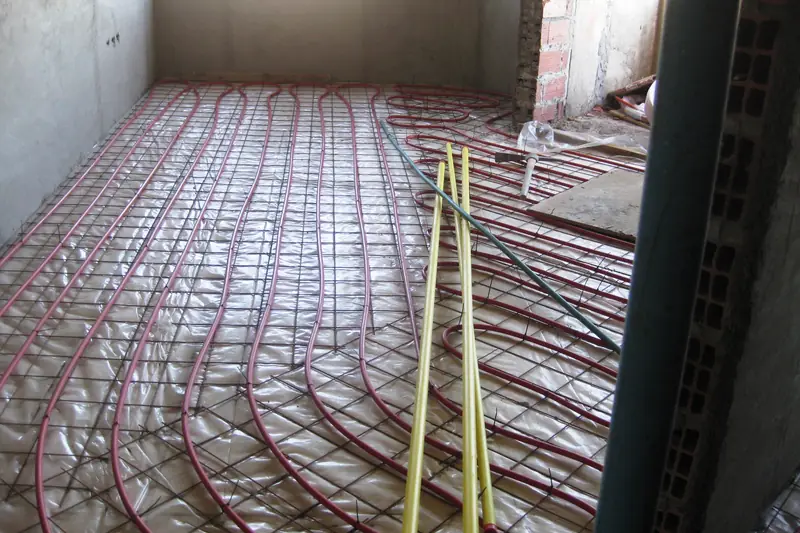
Radiant floor heating moves warm water from a boiler or heat pump through loops of plastic tubing, so the floor itself becomes a large, low-temperature heater. The tubing runs from a manifold, a brass or plastic header with one outlet per loop, and the water returns to the heat source to be warmed again.
REHAU's radiant heating design manual (2017) describes two families of floor. "Wet" systems bury the tubing in a thick concrete slab or a thin pour of gypsum or lightweight concrete over the subfloor. "Dry" systems set it in grooved panels on top of the subfloor or in aluminum plates under it, between the joists. Dry panels have less mass and respond faster; a slab is slow to warm from cold but then holds an even temperature.
Up here, that slowness matters. The Aspen 1SW weather station (about 8,175 feet) logs about 8,880 heating degree days a year and a January average low of 9.9°F (NOAA NCEI 1991–2020 normals). A slab that runs most of the winter suits that long season better than one that is turned down every morning and expected to catch up by evening.
What water temperature does radiant floor heating use?
Radiant floor heating uses warm water, and the right supply temperature is set by the system's designer for each floor rather than by one valley-wide number. REHAU gives two fixed reference points: water-to-water ground-source heat pumps typically produce water up to 120°F, and non-condensing boilers need mixing controls that protect them from return water below 140°F.
Most systems use an outdoor reset control. REHAU explains that it reads the outdoor air temperature and recalculates the target supply-water temperature through the day, so the floor gets warmer water on a below-zero morning and cooler water on a mild, sunny afternoon. That keeps the room steady and lets a condensing boiler or heat pump run at lower, more efficient temperatures most of the season.
Altitude itself changes little inside a closed water loop. REHAU's manual says elevation in radiant design mainly affects the pressure rating of pipes and components in tall buildings. The burner is another matter: gas boilers at valley elevations need the maker's high-altitude setup, covered in boilers and water heaters at high altitude.
How warm should a radiant floor feel?
A radiant floor should feel barely warm underfoot, not hot. REHAU's Table 5.1 lists typical maximum floor-surface temperatures of 85°F in occupied areas, 91°F in bathrooms and 95°F in perimeter and distribution areas such as hallways. Walls may run up to 95°F because people rarely touch them.
Flooring sets its own limit too. REHAU calls wood "the most sensitive" covering and says every floor covering has a specific temperature limit, so the flooring maker's numbers for the boards, underlayment, adhesive and grout all have to be met. A slab sensor wired to the thermostat can cap the floor temperature for exactly this reason.
If a room cannot be heated without passing those surface limits, REHAU's answer is supplemental heat: a kick-space heater, towel warmer, baseboard, or radiant tubing in the lower walls or ceiling. Big glass walls facing a cold night sky are where that most often comes up in a mountain house.
| Area | Typical max floor surface | Slab-on-grade tubing spacing |
|---|---|---|
| Occupied rooms (living, bedrooms) | 85°F | 12 in |
| Bathrooms | 91°F | 6 in |
| Perimeter by outside walls | 95°F | 6–8 in |
| Hallways and secondary rooms | 95°F | per design |
| Tile over a thin overpour | per flooring maker | 6–9 in |
How are radiant floor zones and manifolds set up?
Radiant floor zones are set up by controlling water flow to individual loops or to whole manifolds. REHAU's manual says a zone can be one loop under a bathroom or many loops working together, and that rooms used at the same times should share a zone while rarely used rooms get their own, so their thermostats can be set back.
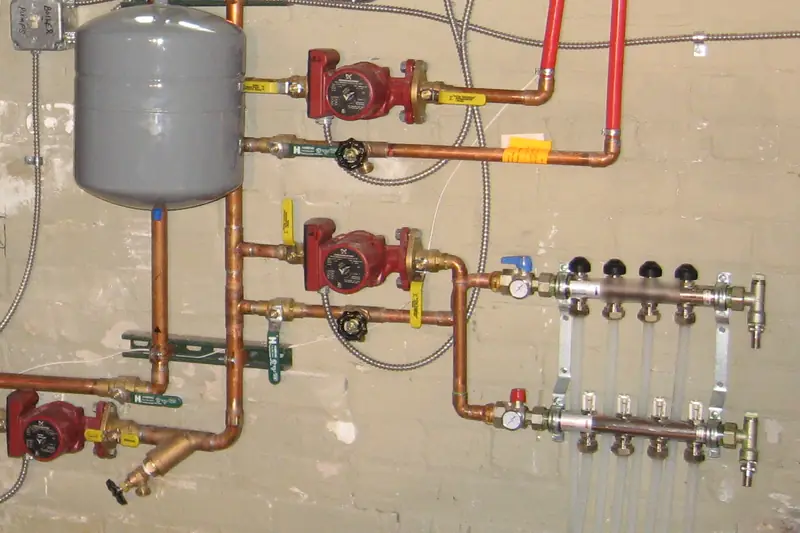
Each manifold should sit close to the rooms it serves and stay reachable for future service: REHAU lists mechanical rooms, closets behind an access panel, under stairs and recessed wall cabinets. Flow to a zone is switched by a zone valve, a zone pump or, on some manifolds, a small actuator on each loop. Thermostats for radiant floors can read both room air and an embedded slab sensor.
PlumbingSupplyAndMore stocks the kind of radiant heat controls (part of Upvalley Heat's ownership group) and zone valves (PlumbingSupplyAndMore, part of Upvalley Heat's ownership group) a hydronic technician fits; browsing them shows what the parts look like before a contractor quotes a repair or an added zone. Wiring and piping them is technician work.
Can a heat pump run radiant floor heating?
Yes, a heat pump can run radiant floor heating, because the floor needs only warm water. REHAU calls radiant heating "ideal" for ground-source heat pumps, which typically make water up to 120°F. Air-to-water units are the newer option for homes without room for ground loops.
Rebates follow the equipment. Holy Cross Energy's 2026 residential rebates (read October 2026) pay $3,500 per heat pump project ($7,000 income-qualified), list air-to-water and split-hydronic systems as eligible, require a cold-climate unit, enrollment in Peak Time Payback and an application within 90 days of the invoice. Its 2026 worksheet even names "Natural Gas Boiler (in-floor)" among systems being replaced. Programs change; check before you buy. Black Hills Energy's 2026 gas rebates pay $675 or $1,000 for 90% or 95% AFUE boilers and $300 for a boiler outdoor reset control. The full list sits in utility rebates in the Roaring Fork Valley, and the cold-weather limits are in cold-climate heat pumps.
What fails in an older radiant floor heating system?
In an older radiant floor heating system, the trouble is usually in the mechanical room, not the floor. These are the patterns the maker literature describes:
- No oxygen barrier. REHAU warns that tubing without an oxygen diffusion barrier lets oxygen into the water, which corrodes iron and steel pumps, valves and boilers; concrete does not stop it.
- Missing or failed mixing. A non-condensing boiler fed cold radiant return water condenses flue gas; REHAU says this "often results in massive scale formation" on the fire side and aggressive corrosion.
- Oversized circulators. REHAU notes that too much flow causes noise and erosion and can stop zone valves from closing.
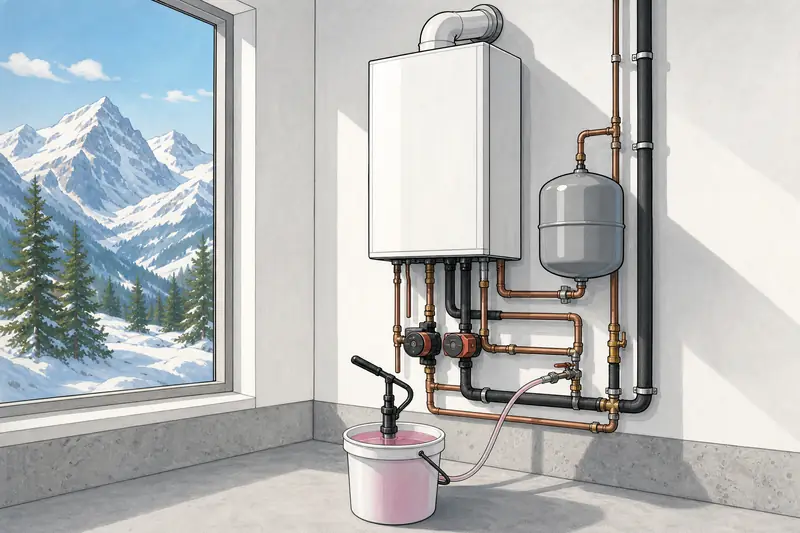
- Worn glycol. Lochinvar warns that the inhibitors in freeze-protection fluid wear out over time, so the fluid needs periodic replacement; see boiler care and glycol.
- Poor insulation. REHAU puts downward and edge losses at up to 50% without proper insulation.
Between visits, glance at the boiler's pressure and temperature gauge, which Lochinvar's manual lists as a daily owner check, and note any drips at the manifold. Leave valves, controls and the boiler cabinet to a licensed technician; if you are not sure what you are looking at, stop and call one. In Aspen (permit triggers) and Glenwood Springs, replacing a boiler needs a mechanical permit, and Pitkin, Basalt and Carbondale publish mechanical permit applications, so expect a permit and ask the building department.
Avalanche report: how this page was checked
This page is based on REHAU's Radiant Heating Systems design manual (855.601, 2017: Tables 5.1 and 6.2, sections 5.4–5.11), Lochinvar's Knight boiler manual for models 80–285, NOAA NCEI 1991–2020 normals for Aspen 1SW, Holy Cross Energy's 2026 residential rebate page and worksheet, and Black Hills Energy's 2026 gas rebate application, all read October 2026. Left out: any single "typical" supply-water range, because no maker source opened gives one; flooring-specific temperature limits, which come from each flooring maker; and installation costs, which vary by house and were not sourced.
Lift-line questions
Can radiant floor tubing go under hardwood?
Yes, but wood is the covering REHAU calls most sensitive to heat. The flooring maker must approve the product for radiant use, and the floor, underlayment and adhesive limits all have to be met, often with a slab or floor sensor capping the temperature.
Why does a slab take so long to warm up after a setback?
A concrete slab is a large thermal mass, and REHAU notes such systems have a slow response at start-up. Deep setbacks in a cold snap can leave rooms cool for hours, so many slab systems hold a steadier temperature and let outdoor reset do the adjusting.
Is closer tubing spacing always better?
No. REHAU's residential slab spacing is about 12 inches in living areas, tighter at 6 inches in bathrooms and 6–8 inches near outside walls, because those spots need more output. The designer sets spacing from the room's heat loss, not as a single rule.
Does altitude change how a radiant loop is sized?
Very little inside the water loop. REHAU says elevation mainly affects pipe pressure ratings in tall buildings. The gas burner is different: between 5,762 feet in Glenwood Springs and 8,208 feet in Snowmass Village (USGS elevation at each town's map point), boilers need the maker's high-altitude setup.
Can a water heater supply radiant floor heat?
REHAU says domestic hot water or dual-purpose tanks suit some applications when properly plumbed and allowed by code, and heating water must never mix with drinking water. Whether it works for a given house is a designer's call.
What do the small actuators on a radiant manifold do?
On manifolds with flow control on each loop, an actuator and a room thermostat let each circuit open or close by itself. That is how one manifold can serve several rooms at different temperatures.
Does radiant floor heating need antifreeze?
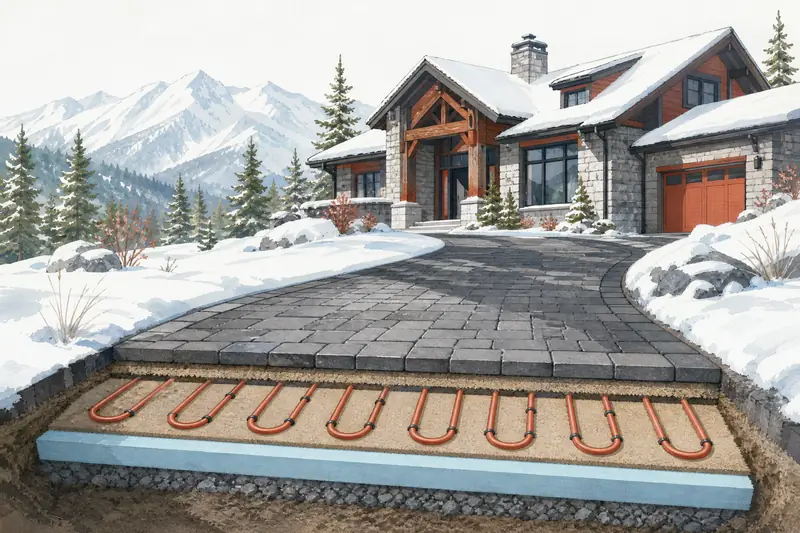
Indoor floors usually do not, but systems with snowmelt or loops in unheated spaces often do. Where glycol is used, Lochinvar specifies an inhibited propylene glycol formulated for hydronic loops, tested yearly at minimum.
Next runs
Back to the base lodge: the valley elevation profile and topic list