Furnace Altitude Derating, Explained
Furnace altitude derating means turning down a gas furnace's input so it burns cleanly in thin air; the default rule is about 4% per 1,000 feet, but each maker's manual decides.
Written by the Upvalley Heat desk from manuals and official pages · how figures are sourced · Rechecked
First tracks
- The default rule makers quote from the National Fuel Gas Code: cut gas input 4% for each 1,000 feet above sea level once a furnace sits at 2,000 feet or higher (Trane installer's manual, 2020).
- Not every furnace follows that default: Carrier's 59SC5A manual (2019) calls for 2% per 1,000 feet, so the model's own manual governs.
- Every valley town sits between 5,762 feet (Glenwood Springs) and 8,208 feet (Snowmass Village) at its USGS map point, above the level where most makers want high-altitude parts or settings.
- Kit thresholds vary by maker: Trane's pressure-switch kit starts above 4,000 feet, Lennox's EL297 above 4,500 feet, and Lennox orifices change from 7,501 feet.
- Black Hills Energy bills gas by heat content corrected for altitude (tariff, 2016); a technician asks the utility for the local heating value before setting up a furnace.
- All derating work is installer-only. Lennox says installation and service "must be performed by a licensed professional HVAC installer."
What is furnace altitude derating?
Furnace altitude derating is the setup step that lowers a gas furnace's firing rate so the gas it burns matches the oxygen available at your elevation. A furnace's rating plate input is a sea-level number; Carrier says plainly that "the gas input rate on rating plate is for installations at altitudes up to 2000 ft."
Above that height, the installer reduces input using the method in the installation manual. Trane states the default in its S9V2 installer's manual: at 2,000 feet or more, "the Furnace input rate (BTUH) shall be reduced 4% for each 1,000 ft. above sea level," following local code or the National Fuel Gas Code (ANSI Z223.1/NFPA 54).
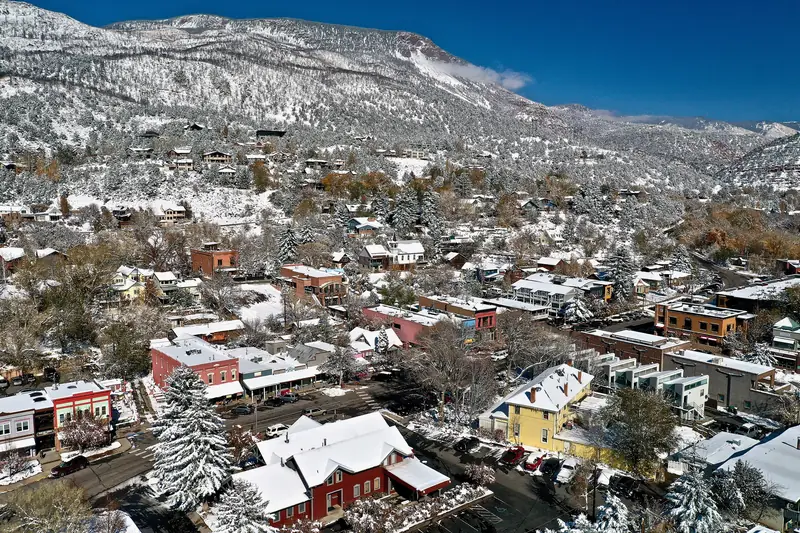
In the Roaring Fork Valley this is never an edge case: from Glenwood Springs (5,762 feet at its USGS point) to Snowmass Village (8,208 feet), every furnace runs far above the 2,000-foot line.
Why does thin air change gas combustion?
Thin air changes gas combustion because each cubic foot of air holds less oxygen at 8,000 feet than at sea level, so a burner fed a sea-level amount of gas cannot burn it cleanly. Turning the input down restores the balance between fuel and air that the burner was designed around.
Air density also affects the parts that prove the furnace is venting. Trane's high-altitude kit sheet explains that "due to the lower density of air at higher altitudes, there would be insufficient negative pressure developed by the induced draft blower to maintain normal operation." That is why the kit swaps the pressure switch rather than only touching the gas side.
The gas matters too. Black Hills Energy, whose tariff lists all six towns, adjusts your metered Btus "to account for the local atmospheric pressure." Carrier warns that the heating content of gas at altitude "may already provide for a reduction in capacity," so the technician gets the in-season heating value from the supplier first.
Derating numbers from the manuals
- 4%Default input cut per 1,000 ft, from 2,000 ft upTrane S9V2 installer's manual (2020)
- 2%Carrier 59SC5A input cut per 1,000 ftCarrier 59SC5A manual (2019)
- ±2%Allowed gap from rated or altitude-adjusted inputCarrier 59SC5A manual (2019)
- 10,000 ftHighest install for the Lennox EL297Lennox EL297 instructions (2026)
How much do makers derate furnaces?
Makers derate furnaces by different amounts, and the manual for your exact model is the only figure that counts. Trane and Weil-McLain both print the 4% default; Carrier's 59SC5A condensing furnace uses 2% per 1,000 feet, with a table that multiplies input by 0.87 at 6,001 to 7,000 feet, 0.85 at 7,001 to 8,000 feet and 0.83 at 8,001 to 9,000 feet.
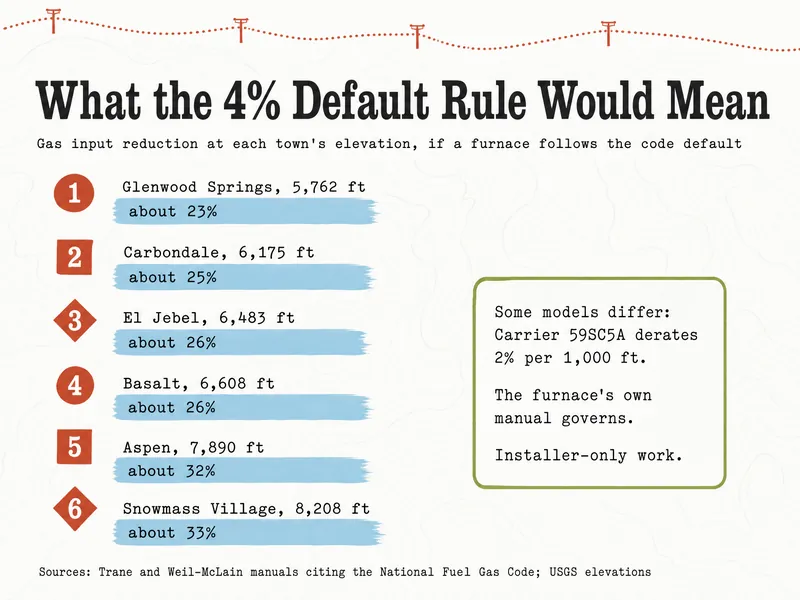
If a furnace did follow the 4% default, the arithmetic for the valley is large. Multiply each town's elevation in thousands of feet by 4% and you get roughly 23% at Glenwood Springs, 25% at Carbondale, 26% at El Jebel and Basalt, 32% at Aspen and 33% at Snowmass Village. Treat those as an illustration of the default rule only; a model certified differently will land somewhere else.
| Town | USGS elevation at the town's map point | Input cut under the 4% default | What actually applies |
|---|---|---|---|
| Glenwood Springs | 5,762 ft | about 23% | The furnace's own manual |
| Carbondale | 6,175 ft | about 25% | The furnace's own manual |
| El Jebel | 6,483 ft | about 26% | The furnace's own manual |
| Basalt | 6,608 ft | about 26% | The furnace's own manual |
| Aspen | 7,890 ft | about 32% | The furnace's own manual |
| Snowmass Village | 8,208 ft | about 33% | The furnace's own manual |
Less input means less heat out, so the heat loss and sizing page matters as much as setup.
Which parts change for high-altitude furnace setup?
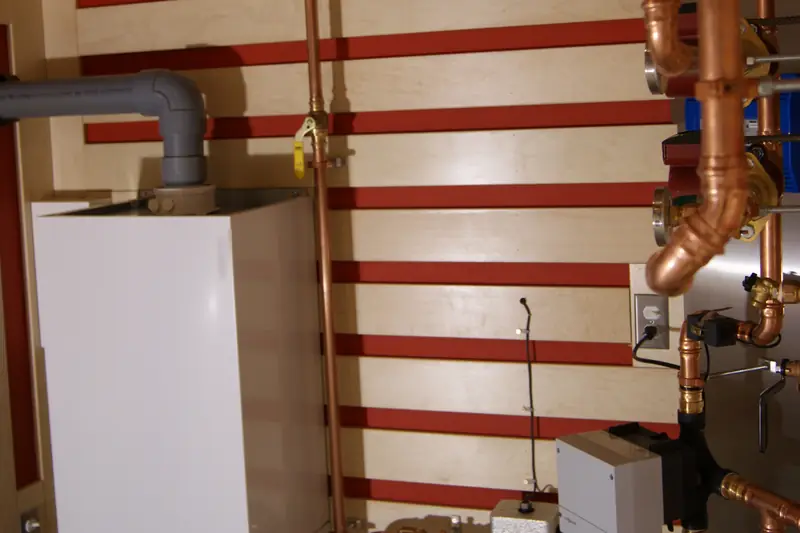
High-altitude furnace setup can change three things, depending on the model: the gas pressure at the burners, the burner orifices and the pressure switch. Each is installer-only work, and none is something to attempt yourself.
- Manifold pressure. Lennox's EL297 manual gives a natural-gas pressure for each altitude band (0 to 4,500, 4,501 to 5,500, 5,501 to 6,500, 6,501 to 7,500 and 7,501 to 10,000 feet).
- Orifices. The same Lennox manual says units at 7,501 to 10,000 feet "require an orifice change." Carrier adds "NEVER ASSUME ORIFICE SIZE" and "DO NOT redrill orifices."
- Pressure switch. Lennox requires a switch change from 4,501 feet; Trane's kit sheet covers furnaces "exceeding an altitude of 4000 feet," while Trane's installer's manual lists optional kits for installations over 5,000 feet.
- Vent length. Carrier's tables shorten the allowed pipe length as altitude rises.
Thresholds differ by maker and even within one maker's paperwork, so there is no single valley-wide rule; every town here simply sits above the point where most makers call for high-altitude parts or settings.
How can you tell a furnace was set up for altitude?
You can tell a furnace was set up for altitude from the installer's records, not from the rating plate, which always shows the sea-level input. Ask the contractor who installed or last serviced it for the measured firing rate, the manifold pressure they set, any kit part numbers fitted and the temperature rise they recorded.
Those are the manuals' own checks. Trane has the installer clock the gas meter using the heating value "obtained from the local utility supplier," and Carrier wants input within 2% of the altitude-adjusted figure and a temperature rise inside the plate's range.
Ask for those numbers in writing. A permit helps too: Aspen and Glenwood Springs say heating replacements need a mechanical permit, and Pitkin County, Basalt and Carbondale publish mechanical permit applications, so expect a permit and ask the building department.
What goes wrong with a furnace not derated?
A furnace not derated for altitude can fail to start, lock out, burn dirty or produce carbon monoxide. Trane's kit sheet warns that if its high-altitude instructions are not followed exactly, "a fire, an explosion or production of carbon monoxide may result."
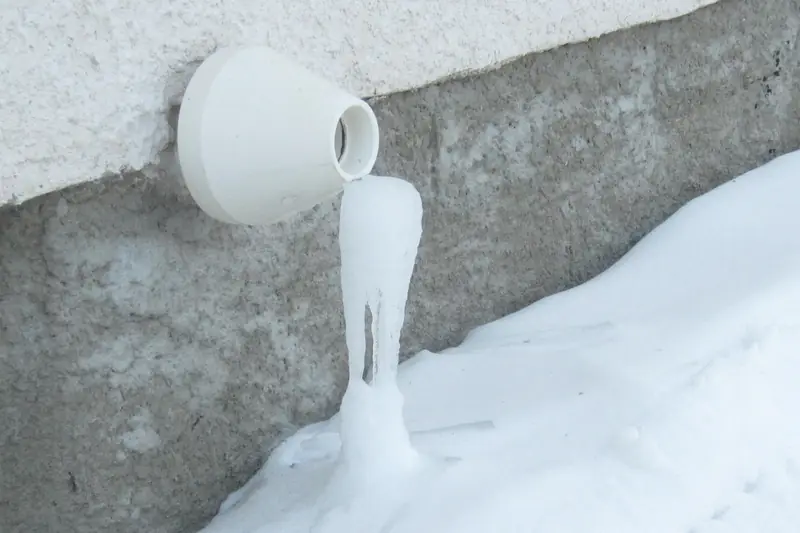
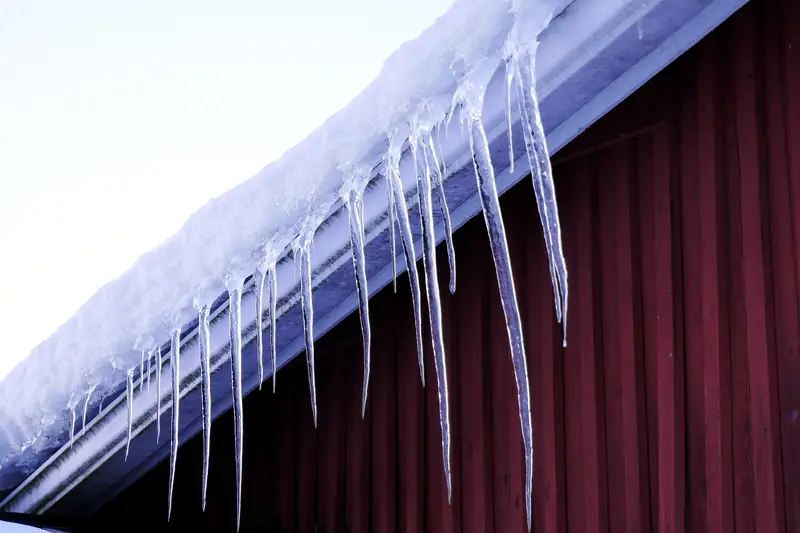
Milder failures look like nuisances: a pressure switch that will not close, flame disturbance, or a temperature rise out of range, which Carrier traces to gas input, derate, ducts or blower speed. Ice building on a high-efficiency exhaust, as in the photo above, is a separate venting issue; if exhaust keeps icing or the furnace keeps locking out, call a qualified technician.
Carbon monoxide is the reason this matters. Under Colorado's 2009 alarm law (C.R.S. 38-45-101 and following), a home with gas appliances that is sold, or that gets permitted work such as a new furnace, needs a working CO alarm no more than 15 feet from the door of every bedroom; the CPSC also advises one on every level. If an alarm sounds or anyone feels headachy, dizzy or sick to the stomach, get everyone out into fresh air, then call 911. Smell gas? Leave first and phone Black Hills Energy once outside, per its smell-of-gas steps; no light switches, phones or flames indoors. Alarm placement is covered on the carbon monoxide safety page.
Your own part is small: a clean filter, a seated front panel and vent pipes cleared of snow by hand. Burners, orifices, gas pressure and switches stay off limits; when in doubt, stop and get a qualified technician. The no-heat checklist lists the checks that stay on the homeowner's side of the line.
Avalanche report: how this page was checked
This page is based on furnace installation manuals opened in October 2026: Trane S9V2 installer's manual 18-CE03D1-1F-EN (May 2020) and its high-altitude kit sheet 18-CH94D1-1C-EN (December 2024), Carrier 59SC5A-13SI (January 2019), Lennox EL297 508581-03 (October 2026) and the Lennox LP kit 508310-01 (March 2026); Weil-McLain's AquaBalance high-altitude addendum (2017); Black Hills Energy's Colorado gas tariff (effective March 2016); USGS 3DEP elevations at each town's GNIS point; Colorado's 2009 carbon monoxide alarm law; and CPSC carbon monoxide pages. Left out: the code text itself (the National Fuel Gas Code could not be opened, so it is quoted only as makers quote it), section numbers, any Btu-per-cubic-foot figure for valley gas, Goodman, Rheem and other brands whose manuals were not opened on a maker's own site, and any step that would have a homeowner change gas settings.
Lift-line questions
Is a high-altitude furnace a different model from a sea-level one?
Usually it is the same model with altitude settings and sometimes a kit; its manual lists which parts change and where. Some appliances are certified with their own altitude rule, which is why Carrier's 59SC5A uses 2% per 1,000 feet instead of the 4% default.
Does derating make my furnace less efficient?
Derating lowers input and output, but it is what lets the furnace burn cleanly here. The AFUE rating is a lab figure; what changes is how many Btu per hour the furnace delivers at your elevation, which is the number to compare with your heat loss.
Can a technician skip derating because valley gas is lower in energy?
Only the manual can answer that for a given model. Carrier and others note that the local heating value may already reduce capacity, so the technician gets the in-season figure from the gas supplier before deciding what to adjust. Black Hills Energy's tariff says it corrects billing for altitude but does not publish a single heating value for the valley.
Who is allowed to install a high-altitude kit?
The makers say a qualified or licensed installer. Trane's kit sheet says it "shall be installed by a qualified service agency," and Lennox reserves installation and service for a licensed HVAC installer, service agency or the gas supplier. In Pitkin County, mechanical contractors also need a City of Aspen contractor license.
Does a propane furnace need a different altitude setup?
Yes. Lennox sells a separate high-altitude propane kit for 7,501 to 10,000 feet, and Carrier sets propane pressures from the LP kit's instructions. This is installer-only work.
What should a furnace replacement quote say about altitude?
It should name your house's elevation, the altitude method from the model's manual and any kit included. Ask for a start-up report with measured input and temperature rise.
More on altitude
Back to the base lodge: the Upvalley Heat home page and its six topics