Snowmelt Systems: How They Work and What They Cost
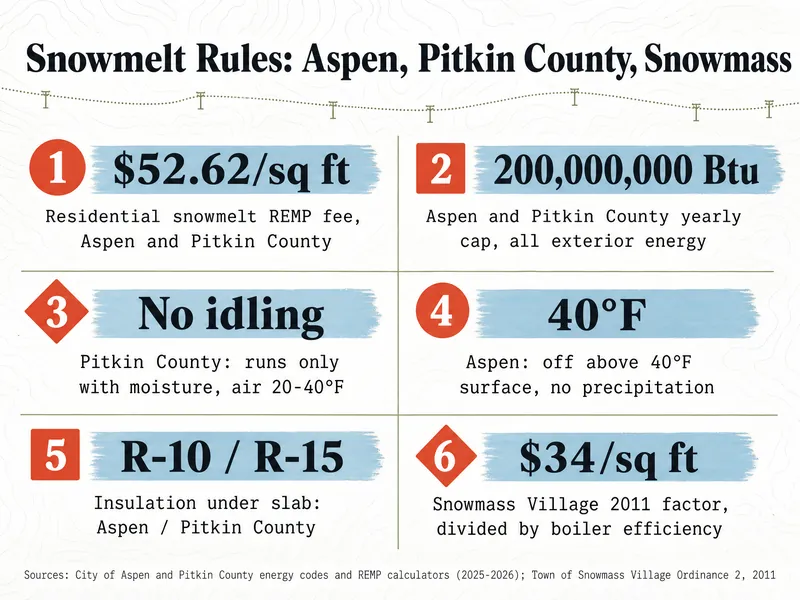
Snowmelt systems heat a driveway or walk from below with warm glycol or electric cable; in Aspen and Pitkin County, a new residential system also carries a REMP fee of $52.62 per square foot.
Written by the Upvalley Heat desk from manuals and official pages · how figures are sourced · Rechecked
Ownership note: Upvalley Heat belongs to the same ownership group as PlumbingSupplyAndMore, Central Plumbing & HVAC, SoftPro Water Systems and Quality Water Treatment, the businesses this page links to. Figures here come from federal, Colorado, county and utility pages and from manufacturers' installation manuals, read in October 2026. What a store says about its own products is the store's claim, not a finding of this site. How partner links work here
First tracks
- Caleffi rates residential walks and drives as Class 1 snowmelt, delivering 80–125 Btu/hr per sq ft; from a cold start such systems can take several hours to clear snow.
- The City of Aspen and Pitkin County REMP calculators (2025 versions) charge $52.62 per square foot of new residential snowmelt unless on-site renewables offset it.
- Both jurisdictions cap all exterior energy uses on a property at 200,000,000 Btu a year; Aspen's code summary equates that to 2,414 sq ft of snowmelt.
- Pitkin County forbids idling a home's snowmelt slab; controls with slab sensing may run it only when it is wet out and the air sits above 20°F but below 40°F.
- Snowmass Village follows its own 2011 offset program: 50% on-site renewables, or a fee of $34 per sq ft divided by the boiler's efficiency.
- A boiler rated 95% AFUE or better serving driveway snowmelt earns $1,815 from Black Hills Energy in 2026; Holy Cross Energy offers no residential snowmelt rebate.
Snowmelt numbers
- 80–125Btu/hr per sq ft delivered by Class 1 residential snowmeltCaleffi idronics, 2021
- 2,414 sq ftSnowmelt area equal to Aspen's yearly exterior energy capCity of Aspen code summary
- $44,347.83Snowmass 2011 example fee in lieu, 1,200 sq ft with a 92% boilerSnowmass Village Ordinance 2, 2011
- $1,815Black Hills hydronic driveway snowmelt rebate, 2026Black Hills Energy
How do snowmelt systems work?
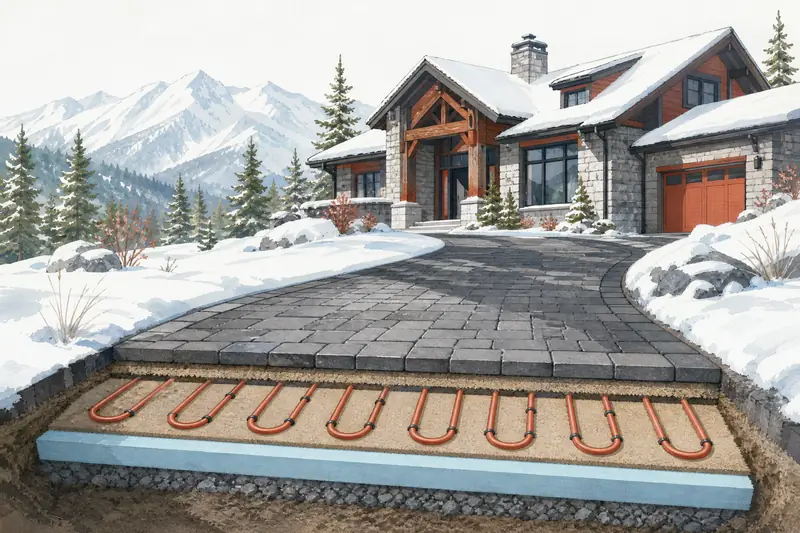
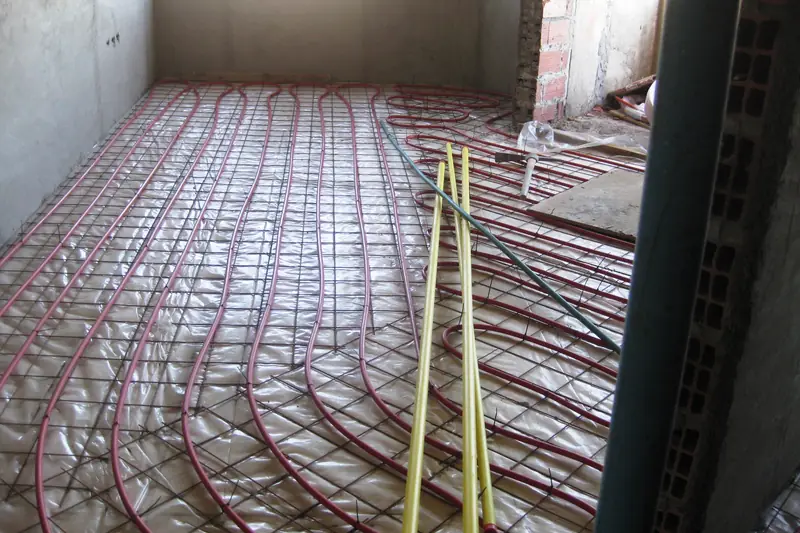
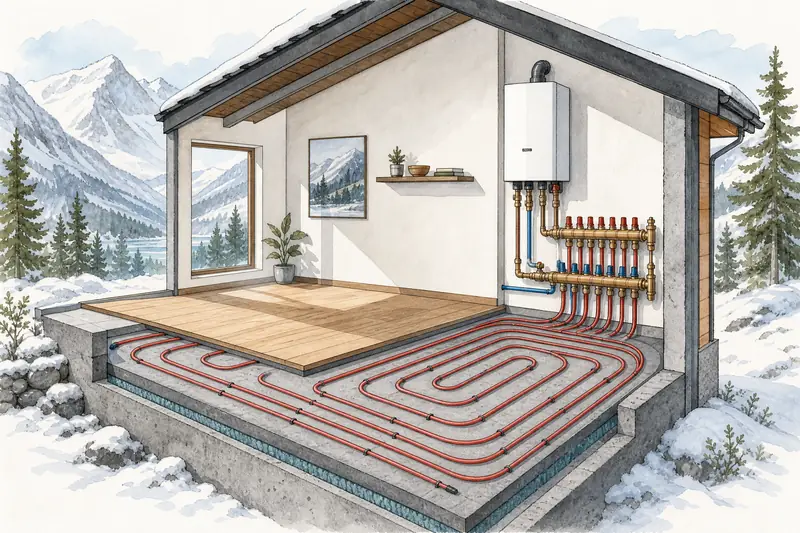
Snowmelt systems work like a radiant floor turned inside out: tubing or cable under the pavement warms the surface enough to melt snow as it lands or soon after. A hydronic system pumps warm fluid from a boiler or heat pump through PEX loops laid in sand or concrete; an electric system uses mats or cable.
Caleffi's idronics article (July 2021) sorts systems into three classes. Class 1, for homes, puts 80–125 Btu/hr into each square foot, which Caleffi says is not necessarily enough to melt snow as fast as a strong storm drops it; several hours may be needed from a cold start. Class 2 (125–250) suits retail sites and Class 3 (250–450) is for places that must never ice, such as hospital entrances. REHAU's snowmelt load selection table (TB250, 2015) sends designers to ASHRAE's handbook for the actual loads.
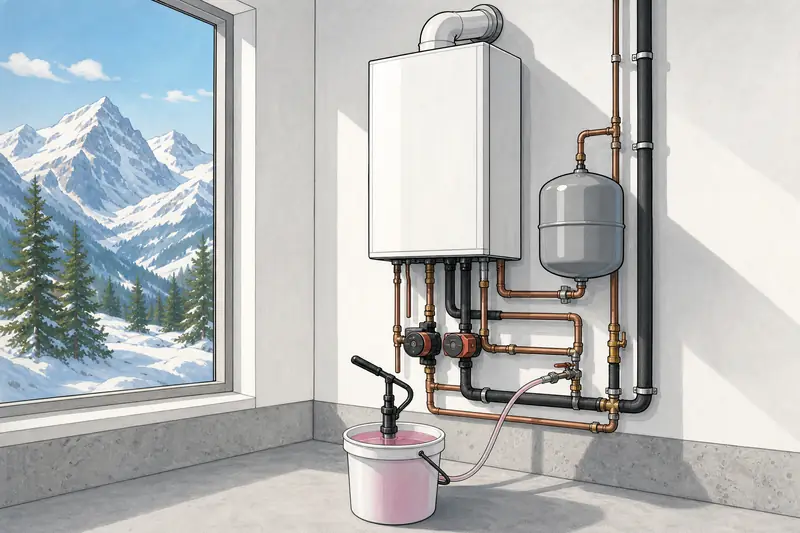
Because the slab sits outside all winter, hydronic snowmelt usually runs on antifreeze. Caleffi notes that snowmelt-only systems often use glycol throughout, while combined systems put a heat exchanger between the slab loop and the house. That glycol needs yearly testing; see boiler care and glycol. PlumbingSupplyAndMore carries the hydronic circulators (part of Upvalley Heat's ownership group) that move that fluid through the slab, the kind of pump a hydronic technician sizes and installs.
What do snowmelt systems cost in REMP fees?
In the City of Aspen and in Pitkin County's own permit jurisdiction, a new residential snowmelt system costs $52.62 per square foot in Renewable Energy Mitigation Program (REMP) fees, unless on-site renewables or efficient equipment earn credits against it. Both the Pitkin County REMP calculator (version 2025.1) and the City of Aspen calculator (version 1.9, April 15, 2025) use that figure.
The calculators assume a residential slab draws 125 Btu per square foot per hour, based on ASHRAE Class 1 loads, over 560 run hours plus 260 clean-up hours a year. At $52.62 a square foot, 1,000 square feet of new heated driveway works out to $52,620 before any credits (simple multiplication; the calculator sheet gives the real figure).
| Jurisdiction | New residential snowmelt | Under-slab insulation | Required controls | Heat source |
|---|---|---|---|---|
| City of Aspen | REMP fee of $52.62 a square foot, or renewable credits | R-10 | off when the surface tops 40°F with no precipitation | condensing boilers limited to 130°F supply; heat pumps and electric permitted |
| Pitkin County | same $52.62 a square foot REMP fee, or credits | R-15 | moisture, air above 20°F and below 40°F, slab sensing; no idling | 95% AFUE or better; condensing boilers limited to 130°F supply |
| Snowmass Village | offset half with on-site renewables, or a fee in lieu built on $34 a square foot over boiler efficiency (2011) | not set in the 2011 ordinance | not set in the 2011 ordinance | exterior boilers 90% AFUE or better (2011) |
Where the fee goes is set by each code. Aspen's energy code puts REMP money into a separate fund spent under a joint City Council and county commissioners resolution; Pitkin's Title 11 has the county commissioners spend it on cutting fossil-fuel use, administering the energy code, education and Climate Action Plan goals. Replacing a system that already paid REMP earns a credit pro-rated over 20 years, and simply swapping a boiler or heat pump does not trigger a new REMP submittal. The details for remodels are in Pitkin County REMP and the energy code.
Snowmass Village is different and must not be priced with Aspen's numbers. Its Renewable Energy Offset Program asks projects with snowmelt, pools and hot tubs to offset 50% of the energy with on-site renewables or pay a fee in lieu. The 2011 ordinance works that out as $34 per square foot divided by the boiler's efficiency: its own example, 1,200 square feet with a 92% boiler, comes to $44,347.83. Single-family garage aprons are exempt for 200 square feet. The Town's building code page lists Chapter 18 updates "as of May 2026," which may have changed these figures, so confirm with the Town before relying on them.
What rules limit snowmelt systems?
Snowmelt rules in the upper valley limit how much exterior energy a property may use, how well the slab is insulated and how efficient the heater must be. The biggest limit is the cap: 200,000,000 Btu a year for all exterior uses together, in both Aspen and Pitkin County, and Pitkin says "there are no exemptions" to it. Aspen's summary of its 2021 code changes says the cap equals 2,414 sq ft of snowmelt, or 603 sq ft of pool, or 466 sq ft of spa.
Pitkin County's Title 11 (effective May 2, 2026) calls for R-15 or more beneath the slab and heaters rated 95% AFUE or better, with heat pumps and electric resistance also permitted; condensing boilers may supply no hotter than 130°F. It also counts hydronic roof and gutter deicing as snowmelt. The 2021 Aspen Energy Code requires R-10 under the melted surface and the same 130°F cap for condensing boilers.
Some areas are exempt. Aspen's REMP excludes access and egress areas the building official approves, including accessible routes up to 48 inches wide and a nine-square-foot portion of an egress window well. A permit comes first either way: Aspen's permit triggers list snowmelt systems as mechanical permit work.
Are snowmelt sensors required?
Yes, automatic snowmelt controls are required in both Aspen and Pitkin County, and the rules differ. Pitkin County's controls rule has three parts: a moisture signal, an outdoor reading above 20°F yet under 40°F, and a slab temperature sensor. Residential slabs may never idle there.
Aspen's code requires controls that shut the system off when the melted surface is warmer than 40°F and no precipitation is falling, plus an automatic or manual shutoff when the outdoor air is above 40°F. Electric heat mats with a factory thermostat that turns on below 35°F and off above 50°F are an exception. For a Class 1 residential slab that needs hours to warm up, a moisture sensor paired with slab sensing is what decides how quickly it can respond to a storm without idling.
Which rebates cover snowmelt systems?
Only a few rebates cover snowmelt systems, and none pays for adding new heated pavement with electricity. Black Hills Energy's 2026 Colorado rebate form (read October 2026) offers $1,815 toward hydronic driveway snowmelt when the boiler is rated 95% AFUE or higher, for equipment installed in 2026 with applications due January 31, 2027. Black Hills must supply the home's main heating fuel for heating rebates to apply.
Holy Cross Energy's 2026 rebate rules have no residential snowmelt rebate; electric snowmelt appears only in a commercial and multifamily custom program, as a replacement for gas-boiler snowmelt. CORE pays toward snowmelt only when a fossil-fuel snowmelt system is replaced with a heat pump, under its cold-climate heat pump category. CORE paused residential incentives in Garfield County and in unincorporated Eagle County within the Roaring Fork Valley from September 30, 2026, while the Town of Basalt and all of Pitkin County stay eligible first come, first served. Programs change; check before you buy. More in utility rebates in the Roaring Fork Valley.
How do you cut a snowmelt system's energy use?
You cut a snowmelt system's energy use mostly at design time: fewer heated square feet, better insulation underneath and controls that never let it idle. Every square foot left out lowers the REMP fee and the share of the 200,000,000 Btu cap the slab uses, so many owners heat only tire tracks, steps or the steepest stretch.
- Insulate past the minimum. R-10 (Aspen) and R-15 (Pitkin County) are floors, not targets.
- Run a condensing boiler cool. Both codes cap condensing boiler supply at 130°F "to allow for efficient boiler operation."
- Use renewables or a heat pump. Both REMP calculators credit ground-source and air-source heat pumps, solar hot water and on-site PV against the fee.
- Electric slabs: follow the cable maker. Chemelex's Raychem design overview (a European document) says not to heat across expansion joints.
Even with a clear drive, brush storm snow off the boiler's outdoor vent pipes by hand. If the boiler keeps shutting down, stop and call a qualified technician; the no-heat checklist lists safe first steps.
Avalanche report: how this page was checked
This page is based on the Pitkin County REMP calculator (version 2025.1) and Title 11 (effective May 2, 2026), the City of Aspen REMP calculator (version 1.9, April 15, 2025), the 2021 Aspen Energy Code and Aspen's summary of code changes and permit triggers, the Town of Snowmass Village REOP page and Ordinance No. 2, Series of 2011, Caleffi's idronics article (2021), REHAU's TB250 load table (2015), Chemelex's Raychem snowmelt design overview, Black Hills Energy's 2026 rebate form, Holy Cross Energy's 2026 rebate rules and CORE's 2026 rebate page, all read October 2026. Left out: operating-cost or energy-use examples from any maker (none was found), Snowmass Village's post-May 2026 figures (not confirmed), and installation prices.
Lift-line questions
Does a heated driveway in Basalt or Carbondale pay REMP?
The REMP rules on this page come from the City of Aspen and Pitkin County codes, and the Snowmass Village offset from that Town's ordinance. Basalt's town website showed no similar program when checked; ask your building department what applies at your address.
Can REMP fees be avoided by installing solar?
They can be reduced. Both REMP calculators give credits for on-site PV, solar hot water and ground-source or air-source heat pumps; the calculator for your jurisdiction shows what offsets what. Fees are paid at permit issuance in Aspen.
Does a replacement snowmelt boiler trigger a new REMP fee?
Not by itself. Pitkin's Title 11 and Aspen's code say upgrades to existing mechanical equipment such as boilers do not need a new REMP submittal, but adding or replacing exterior energy uses does.
Is roof and gutter deicing treated as snowmelt?
In Pitkin County, hydronic roof and gutter deicing counts as snowmelt. Electric heat tape is priced separately by the watt: Aspen charges $3.26 a watt and Pitkin County $3.39, and Aspen exempts the first 1,000 watts.
Why does a residential snowmelt slab take so long to clear?
Class 1 residential systems deliver 80–125 Btu/hr per square foot, and Caleffi notes that several hours may be needed from a cold start. Pitkin County's ban on idling means the slab cannot be held warm in advance.
Can a snowmelt system run on a heat pump?
Yes. Both Aspen and Pitkin County allow electric resistance and heat pump heaters, and CORE's 2026 program funds replacing a fossil-fuel snowmelt system with a heat pump where its rebates remain open.
Next runs
Back to the base lodge: heating and cooling notes for the whole valley