Wildfire Smoke Filtration at Home
Wildfire smoke filtration at home starts with a snug MERV 13 furnace filter, the fan set to On and outdoor air shut off, plus a portable cleaner sized by EPA's CADR table.
Written by the Upvalley Heat desk from manuals and official pages · how figures are sourced · Rechecked
Ownership note: Upvalley Heat belongs to the same ownership group as PlumbingSupplyAndMore, Central Plumbing & HVAC, SoftPro Water Systems and Quality Water Treatment, the businesses this page links to. Figures here come from federal, Colorado, county and utility pages and from manufacturers' installation manuals, read in October 2026. What a store says about its own products is the store's claim, not a finding of this site. How partner links work here
First tracks
- EPA's smoke advice for central systems: a MERV 13 filter, or the highest rating your fan and filter slot can take, fitted snugly with no gaps.
- During smoke, EPA says set the system to recirculate or close the outdoor intake, and switch the fan from Auto to On.
- EPA's sizing table for portable cleaners starts at 65 cfm of CADR for a 100 sq ft room and climbs to 390 cfm for 600 sq ft, assuming 8-foot ceilings.
- A box fan with a MERV 13 filter cut indoor smoke cost-effectively in EPA research; EPA says use fans made in 2012 or later.
- AirNow's AQI turns "Unhealthy for Sensitive Groups" at 101 and "Unhealthy" at 151; PM2.5 is the smoke number to watch.
- Changing a furnace filter is homeowner work; anything inside the blower or controls belongs to a qualified technician.
How do you keep wildfire smoke out of a house?
Keep wildfire smoke out by closing the house, stopping outdoor air from being pulled in, and filtering what is already inside. The EPA's wildfires and indoor air page lists the steps: close windows and doors, set any system with a fresh-air intake to recirculate or shut its outdoor damper, and run filtration as much as you can.
Colorado's health department gives the same order. CDPHE's wildfire smoke page says to close the outdoor air intake or use recirculate mode, run the system fan continuously, and set up a clean room: one room where people spend most of their time, kept shut and filtered. In a valley that has lived through fires such as the 2020 Grizzly Creek Fire in Glenwood Canyon, it pays to pick that room before the smoke arrives.
When the air outside improves, even for a few hours, EPA suggests airing the house out by opening windows or the fresh-air intake and running the kitchen and bath fans. Then close up again before the smoke returns.
Does a MERV 13 filter help with wildfire smoke?
Yes: EPA and CDPHE both name MERV 13 as the filter to use for smoke in a forced-air system. EPA's wording is a MERV 13 filter "or as high a rating as your system fan and filter slot can accommodate." CDPHE adds that MERV 13 or higher is best for the fine particles in smoke.
Fit matters as much as the rating. EPA says the filter should sit snugly so air cannot slip around its edges, and it should never be bent or crushed to fit. If you are not sure your blower can push air through a denser filter, EPA suggests asking an HVAC technician which rating the system can handle.
A few points come straight from furnace manuals. Carrier's 59SC5A installation manual says the airflow arrow on the filter points toward the blower, and that the furnace must not operate filterless or with its filter access panel open; Carrier files that warning under carbon monoxide and fire hazards. The same manual limits untrained owners to basic tasks such as cleaning and replacing filters. When in doubt at the furnace, stop and have a qualified technician do it.
During heavy smoke, EPA says to keep spare filters on hand and change them more often than the maker's schedule. A filter that looks gray and loaded after a smoky week is doing its job; replace it rather than waiting for the usual interval.
PlumbingSupplyAndMore's indoor air quality section (part of Upvalley Heat's ownership group) lists pleated furnace filters from MERV 8 up to MERV 13 in common 1-inch and 2-inch sizes (category read October 2026). Measure the filter now in your furnace, which prints its size on the frame, and match length, width and depth exactly.
How big a portable air cleaner do you need?
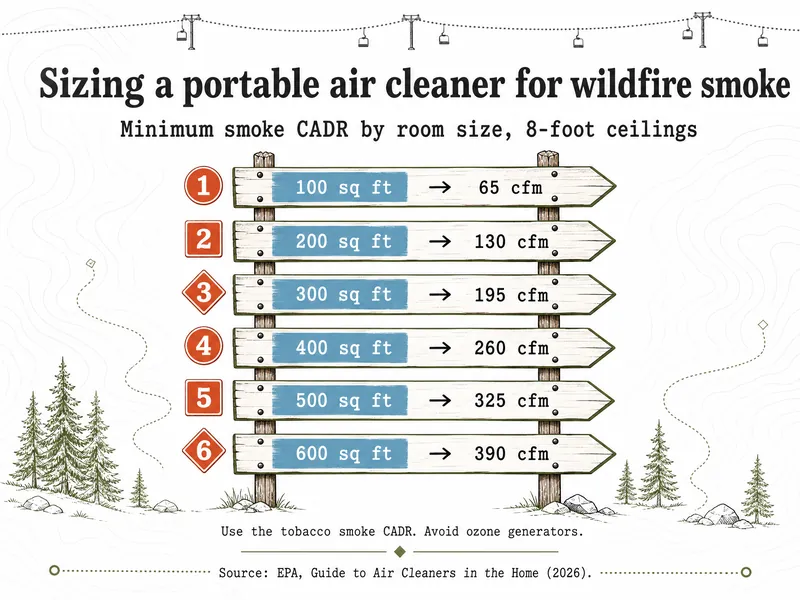
Size a portable air cleaner by its clean air delivery rate (CADR) for smoke against the floor area of the room. EPA's page on air cleaners in the home gives a minimum CADR for each room size, based on 8-foot ceilings.
| Room area | Minimum CADR | Example room |
|---|---|---|
| 100 sq ft | 65 cfm | Small bedroom |
| 200 sq ft | 130 cfm | Large bedroom |
| 300 sq ft | 195 cfm | Family room |
| 400 sq ft | 260 cfm | Open kitchen and dining |
| 500 sq ft | 325 cfm | Great room |
| 600 sq ft | 390 cfm | Open main floor |
The label on most cleaners shows three CADR numbers: tobacco smoke, dust and pollen. EPA says to use the tobacco smoke figure, because it stands for the smallest particles. Mountain homes often have vaulted living rooms; EPA notes that ceilings above 8 feet call for a higher CADR than the table shows.
Skip anything sold as an ozone generator. EPA says to avoid air cleaners and HVAC filters that intentionally make ozone, a lung irritant, and notes that some ionizers, electrostatic precipitators and plasma units may also give off ozone. Place the cleaner where people spend the most time and run it on its highest speed as much as you can.
Do DIY box-fan filters work?
Yes, within limits. EPA's DIY air cleaner research found that a box fan with a MERV 13 filter attached is a cost-effective way to cut smoke indoors, and that a cardboard shroud, a 4-inch filter instead of a 1-inch one, or two to five filters raise the delivery rate further.
Safety testing with Underwriters Laboratories found no fire hazard in the box fans tested, even with loaded filters and both sides blocked for seven hours. EPA still says to use only newer certified box fans (2012 models or later), which have fused plugs and thermal cutoffs, and to keep them clear of obstructions. EPA also notes that commercial cleaners with a known CADR are usually preferred, and that any air cleaner is one part of a plan, not a substitute for ventilation.
How do you read the AQI during wildfire smoke?
Read the AQI for particle pollution, which covers PM2.5, the fine particles in smoke. AirNow's AQI basics splits the index into six bands, and a value of 100 or below is generally thought of as satisfactory.
Smoke thresholds and filter numbers
- 101AQI where "Unhealthy for Sensitive Groups" beginsAirNow
- 151AQI where "Unhealthy" begins for everyoneAirNow
- MERV 13Filter rating EPA names for smoke in a central systemEPA
- 65 cfmMinimum smoke CADR for a 100 sq ft roomEPA
- 2012Oldest box fan model year EPA advises for DIY cleanersEPA
The six AirNow bands run Good (0 to 50), Moderate (51 to 100), Unhealthy for Sensitive Groups (101 to 150), Unhealthy (151 to 200), Very Unhealthy (201 to 300) and Hazardous (301 and higher). Smoke in a narrow valley can change by the hour, so check the current reading before opening up the house, and follow CDPHE's health advice for your group.
What about HRVs, ERVs and fresh air during smoke?
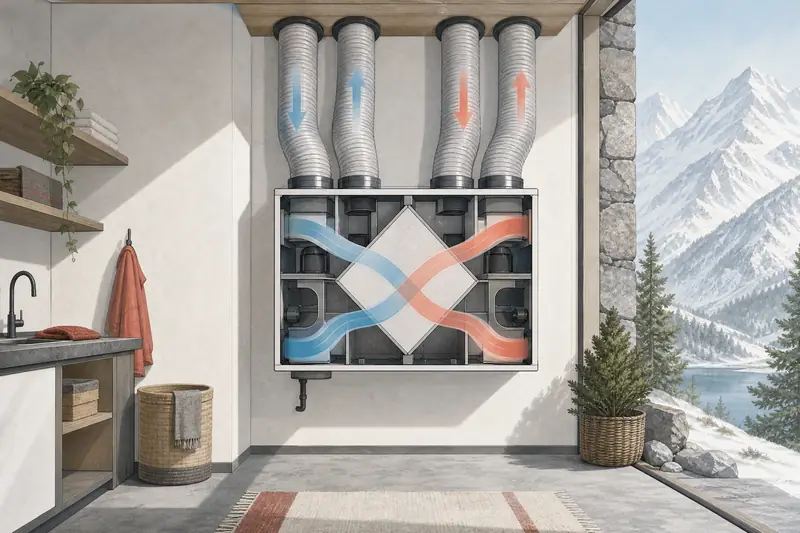
An HRV or ERV pulls outdoor air in on purpose, so during smoke it counts as one of the fresh-air intakes EPA and CDPHE say to close. Learn from the owner's manual how your unit's controls lower or pause ventilation, and turn it back up once the AQI drops; the HRV and ERV ventilation page covers how these units run.
Check the manual before switching anything off for days. Broan's owner's manual for its HRV150S, HRV190S and ERV180S units says that where ventilation ducts run through an unheated space such as an attic, the unit must keep operating except during maintenance or repair. In that case, ask a qualified technician how to cut outdoor air safely during smoke.
Smoke season also overlaps with other indoor-air jobs. A shut house in winter dries out fast, which the humidifier page covers, and any home with gas appliances needs working alarms, as set out on the carbon monoxide safety page. The indoor air overview ties the three together.
Avalanche report: how this page was checked
This page is based on EPA's Wildfires and Indoor Air Quality page (updated September 2026), EPA's Air Cleaners in the Home page (updated October 2026), EPA's DIY air cleaner research summary (updated July 2026), AirNow's AQI Basics, CDPHE's wildfire smoke and health page, Carrier's 59SC5A furnace installation manual and Broan-NuTone's HRV150S/HRV190S/ERV180S owner's manual, all read in October 2026. Left out: brand rankings of air cleaners, any claim about how much a given filter lowers indoor PM2.5 in a specific house, health effects beyond what EPA and CDPHE state, and filter-change intervals beyond EPA's "more often than the manufacturer recommends" during heavy smoke.
Lift-line questions
Can a MERV 13 filter hurt an older furnace?
It can if the blower cannot move enough air through it. EPA says to use MERV 13 or the highest rating the fan and filter slot can take, and to ask an HVAC technician when you are unsure. The furnace manual and that technician decide, not the filter label.
Should the furnace fan run all day during smoke?
EPA says to set the fan to On instead of Auto while the air is smoky, so air passes through the filter even when the house isn't calling for heat. Go back to Auto once the AQI improves. Expect to change the filter sooner when the fan runs constantly.
Does a mini-split or baseboard home have any central filter?
Electric baseboard and hydronic homes have no ducted filter to upgrade. In those homes EPA's advice points to portable cleaners sized by CADR, a clean room, or a DIY box-fan cleaner with a MERV 13 filter.
Is a portable cleaner with an ionizer a problem?
It can be. EPA warns that some ionizers, electrostatic precipitators and plasma air cleaners may give off ozone, and says to avoid devices that make ozone on purpose. Look for a unit with a published smoke CADR and a filter that does the cleaning.
How many portable cleaners does a vaulted great room need?
EPA's table assumes 8-foot ceilings, so a tall room needs more CADR than its floor area suggests. EPA also says that for an open plan, size for the whole space the cleaner serves. Two smaller units, or one in a closed-off clean room, are other options.
When is it safe to air the house out after a smoke event?
EPA suggests opening windows or the fresh-air intake whenever outdoor air quality improves, even briefly, and running kitchen and bath exhaust fans. Use the current AirNow reading for your town rather than how the sky looks.
Should ducts be cleaned after a wildfire?
EPA says ducts should be cleaned only as needed, for example when they are clogged with dust and debris or particles blow out of the supply registers. A fresh filter is the first step after smoke.
Next runs
Back to the base lodge: Roaring Fork Valley heating, town by town