HRV and ERV Ventilation for Tight Homes
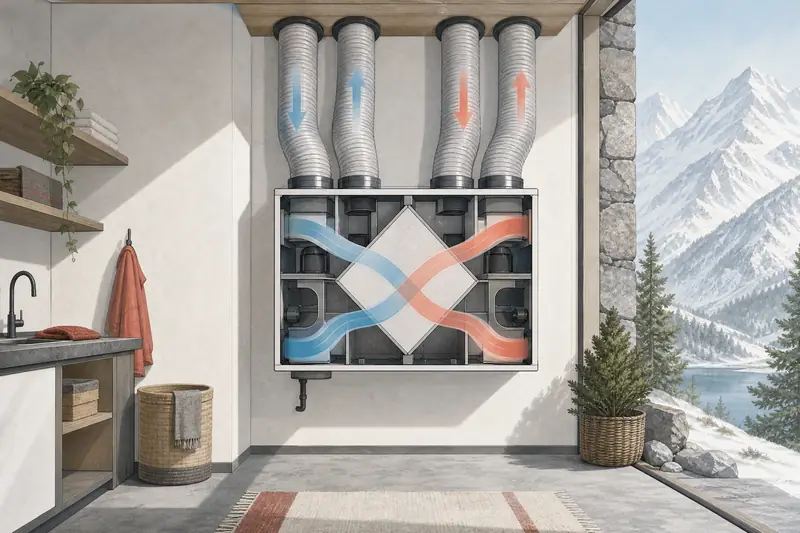
HRV and ERV units bring a tight house fresh air while keeping most of the heat: stale air leaves, outdoor air enters, and the two streams trade warmth through a core without mixing.
Written by the Upvalley Heat desk from manuals and official pages · how figures are sourced · Rechecked
Ownership note: Upvalley Heat belongs to the same ownership group as PlumbingSupplyAndMore, Central Plumbing & HVAC, SoftPro Water Systems and Quality Water Treatment, the businesses this page links to. Figures here come from federal, Colorado, county and utility pages and from manufacturers' installation manuals, read in October 2026. What a store says about its own products is the store's claim, not a finding of this site. How partner links work here
First tracks
- DOE describes two kinds of energy-recovery ventilation: heat-recovery ventilators (HRVs) and energy-recovery ventilators (ERVs), which also pass some water vapor between the air streams.
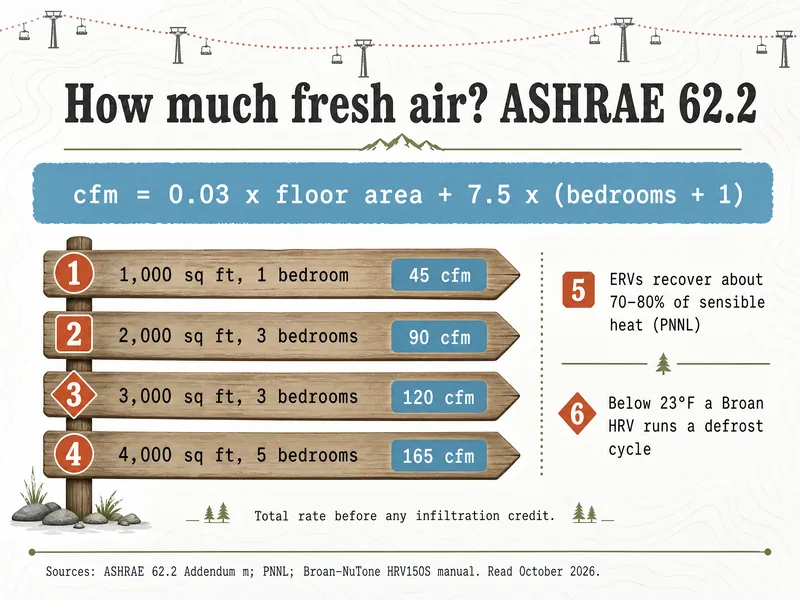
- PNNL's Building America guidance says most ERVs recover about 70% to 80% of the sensible heat in the outgoing air.
- ASHRAE 62.2 sets a home's total ventilation at 0.03 cfm per square foot plus 7.5 cfm per person, counted as bedrooms plus one: 90 cfm for a 2,000 sq ft, three-bedroom house.
- Broan's HRV150S, HRV190S and ERV180S manual says the core starts to frost below 23°F, so the unit runs a defrost cycle.
- CDPHE says radon is elevated in one of every two Colorado homes; EPA calls an HRV a secondary way to lower it.
- Broan's maintenance schedule: filters and intake hood every 3 months, the core each fall, and a qualified service check once a year.
What do HRV and ERV ventilation systems do?
An HRV or ERV runs two fans at once: one pushes stale indoor air out, the other pulls the same amount of outdoor air in, and both streams pass through a heat exchanger. The Department of Energy's energy recovery ventilation page says this cuts the cost of heating ventilation air in winter, because warmth from the outgoing air moves to the cold incoming air.
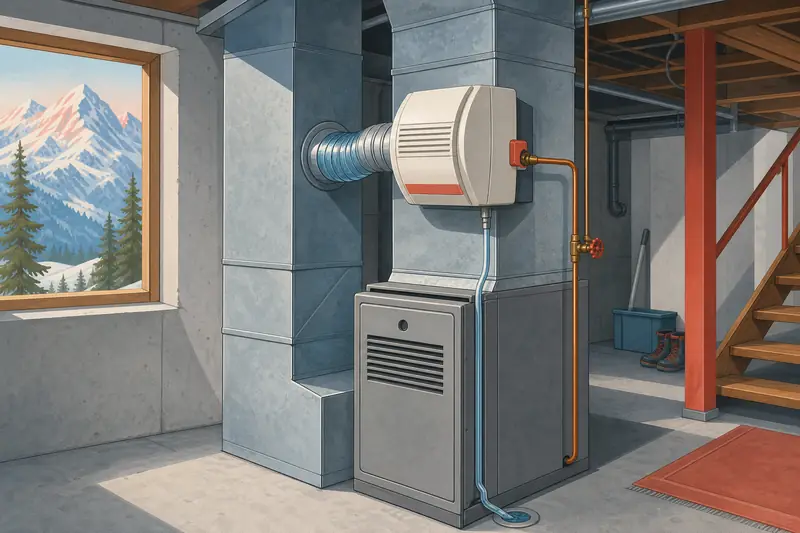
PNNL's whole-house ventilation strategies call this balanced ventilation: the house is neither pressurized nor depressurized. That sets it apart from exhaust-only ventilation (bath and kitchen fans pulling air out through leaks) and supply-only ventilation (an outdoor duct tied into the furnace return). An HRV or ERV can share the furnace ducts or run its own small duct system, which suits homes heated by radiant floors, baseboard or mini-splits.
The reason tight mountain homes need one is simple. PNNL explains that newer airtight houses tend to hold onto moisture and pollutants from cooking, bathing and daily life, and that building codes require whole-house mechanical ventilation in relatively airtight homes. A well-sealed house in Basalt or Snowmass Village keeps its heat, but it also keeps everything the people inside put into the air.
Which suits a dry mountain climate, an HRV or ERV?
Either can work; the real difference is moisture. DOE says ERVs move a certain amount of water vapor along with heat, which helps indoor humidity stay steadier, while an HRV moves heat only. In a valley winter where EPA's 30% to 50% indoor humidity range is hard to hold, an ERV hands some of the moisture in the outgoing air back to the incoming stream.
An HRV in a dry climate is still common, and it has a moisture lever of its own. Broan's owner's manual for the HRV150S, HRV190S and ERV180S lists "air too dry" as a troubleshooting item and suggests running the unit at low speed, switching to intermittent mode if available, or using a humidifier for a while. For condensation on windows, the same manual suggests the opposite: run the unit at maximum during cooking and gatherings. PNNL adds that the maker's specifications decide which model fits which climate.
| Type | How air moves | Moisture | What PNNL and DOE note |
|---|---|---|---|
| HRV | Balanced supply and exhaust through a heat exchanger | Heat only | Higher cost, more maintenance, filter changes |
| ERV | Balanced, like an HRV | Passes some water vapor too | Most recover about 70% to 80% of sensible heat |
| Exhaust-only | Fans pull air out; outdoor air leaks in | None recovered | Works well in cold, dry climates; can depressurize a house |
| Supply-only | Outdoor duct to the furnace return | None recovered | Pressurizes the house; airflow hard to verify |
How much fresh air does a home need?
ASHRAE Standard 62.2 gives the total rate as 0.03 cfm times the floor area in square feet, plus 7.5 cfm times the number of bedrooms plus one. That formula comes from Addendum m to ASHRAE 62.2-2013, which also says to count at least one bedroom.
Run it for a 2,000 sq ft, three-bedroom house in Carbondale: 0.03 × 2,000 = 60, plus 7.5 × 4 = 30, so 90 cfm in total. That is the whole-house figure before any credit for air leaking through the shell; local codes may use different rates, and PNNL notes that model codes can lag the latest standard.
Ventilation and radon numbers
- 90 cfmASHRAE 62.2 total for 2,000 sq ft and 3 bedroomsASHRAE
- 70–80%Sensible heat most ERVs recover from exhaust airPNNL
- 23°FOutdoor temperature where a Broan HRV/ERV core starts to frostBroan-NuTone
- 1 in 2Colorado homes with elevated radonCDPHE
- 4 pCi/LEPA action level for radonCDPHE
Getting the delivered airflow to match the design is commissioning work. PNNL says HRVs and ERVs can be hard to install and to verify once running, that a poorly balanced unit can depressurize a home, and that new systems should be checked by a trained HVAC technician or energy rater. Supply and return grilles are part of that balance: a register shut or covered by furniture changes the flow in that room. PlumbingSupplyAndMore's registers and grilles section (part of Upvalley Heat's ownership group) shows the ceiling diffusers, sidewall registers and return grilles that terminate these ducts; the installer sizes and sets them during balancing.
How do HRVs and ERVs handle deep cold?
They defrost. Broan's manual says that when the outdoor temperature drops below 23°F, recovering heat or energy makes frost in the core, so the unit is programmed to defrost it; during the cycle it shifts to maximum speed and its dampers close. Aspen's town weather station averages a January low of 9.9°F (NOAA 1991–2020 normals for Aspen 1SW), so outdoor air below 23°F is routine there in winter.
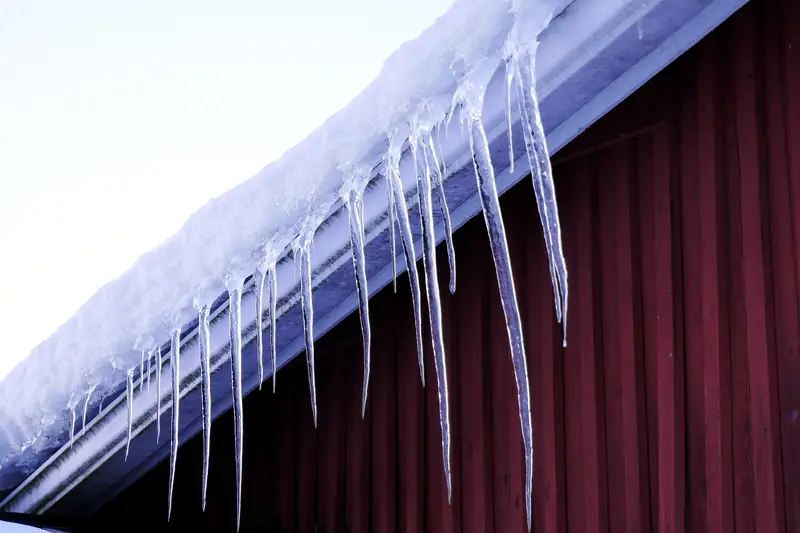
Snow and ice outside matter as much as frost inside. Broan's quarterly checklist includes the exterior air intake hood: no leaves, twigs, ice or snow that could be drawn in, because even partial blocking can make the unit malfunction. Clear a hood by hand or with a soft brush. If supply air feels cold at the grilles, Broan's troubleshooting list starts with the outdoor hoods, then has the balancing and defrost system checked by a technician.
Broan adds two warnings for second homes. When the house is empty more than two weeks, someone should check the unit regularly, and if its ductwork passes through unconditioned areas like an attic, the manual wants it left on except while being serviced. The same manual says the house should never drop below 65°F in that case, which is stricter than the 55°F frozen-pipe floor on the frozen pipes page; follow your own unit's manual.
Does ventilation help with radon?
It can, but EPA treats it as a secondary option. EPA's 2016 radon reduction booklet for consumers says an HRV can lower radon by adding ventilation and works best when it ventilates only the basement.
Testing comes first. CDPHE's radon testing page says elevated radon turns up in one of every two Colorado homes, and its FAQ sets the next step by result: at or above 4 pCi/L, the EPA action level, plan to mitigate; 2 to 3.9 pCi/L, consider a long-term test; under 2, retest in 5 years. CDPHE notes 4 pCi/L is an action level, and it offers one free test kit per household per year while supplies last.
CDPHE's test conditions suit winter: close windows and exterior doors 12 hours before and during a test of at least 48 hours, with heating running normally. Ask whoever set up your ventilation whether the HRV should run as usual during the test.
What upkeep do HRV and ERV units need?
Plan on a short service every 3 months and a deeper one each fall. Broan's schedule for its HRV150S, HRV190S and ERV180S units starts with disconnecting power, then cleaning the door, washing the filters in warm water with mild soap, wiping the condensation tray and clearing the outdoor intake hood.
Each fall, Broan adds core and blower cleaning, and here HRV and ERV differ. An HRV core soaks in cold or lukewarm water with mild dish soap, never hot water or strong detergent. An ERV core cannot be washed with water at all; it gets vacuumed with a soft brush. Broan also says a qualified service person should inspect the unit's mechanical and electronic parts at least once a year. Stop and leave the work to a qualified technician if any step goes past the filters, tray, core and hood.
Upkeep also ties to the rest of the house. During wildfire smoke, EPA and CDPHE say to close outdoor air intakes, which includes an HRV or ERV; the wildfire smoke filtration page covers how. A tight house with gas appliances needs working alarms too, as the carbon monoxide page explains.
Avalanche report: how this page was checked
This page is based on DOE's energy recovery ventilation page, PNNL's Building America whole-house ventilation strategies (Table 3), Addendum m to ANSI/ASHRAE 62.2-2013 (approved 2015), Broan-NuTone's owner's manual for the HRV150S, HRV190S and ERV180S (manual 22644 rev. 03), CDPHE's radon pages, EPA's 2016 consumer booklet on radon reduction (2025 cover) and NOAA's 1991–2020 normals for Aspen 1SW, each read in October 2026. Not covered: brand rankings, installed costs, sensible-recovery figures for specific models, infiltration credits in the ASHRAE formula, and any radon "safe level".
Lift-line questions
Can an HRV replace bath and kitchen exhaust fans?
Not on its own. PNNL treats kitchen and bath fans as local exhaust that runs when moisture is made, while whole-house ventilation runs continuously or on a schedule. PNNL's examples include HRVs that pull stale air from bathrooms and laundry rooms, but local fans still handle bursts of steam and cooking fumes.
Should an HRV run all the time?
PNNL says whole-house ventilation is meant to run continuously or at frequent automated intervals to meet the target rate. Broan's manual adds that units with ducts in unheated space must keep running except during maintenance. Use the controls to change speed rather than switching it off.
Why does my ERV core say not to wash it?
Broan's manual says the energy recovery core cannot be washed with water; vacuum it with a soft brush instead. An HRV core from the same series can soak in cool, mildly soapy water. Check which core your unit has before cleaning.
Does an HRV dry out a house in January?
It can add to winter dryness, since PNNL notes that outdoor air in cold, dry climates is generally drier than the air indoors. Broan's troubleshooting list for dry air suggests lower speed, intermittent mode or a humidifier for a time. An ERV keeps some moisture indoors, per DOE.
How do you know an HRV is balanced?
Balancing is measured, not judged by feel. PNNL says new systems should be commissioned by a trained HVAC technician or energy rater to verify airflow. Keep supply and return grilles open and uncovered between visits.
Will an HRV fix a 6 pCi/L radon result?
EPA calls an HRV a secondary radon option that works best ventilating only the basement. At or above 4 pCi/L, CDPHE says to plan mitigation, and a retest after any change shows whether it worked.
Does a second home need its HRV checked while empty?
Broan's manual says a responsible person should check the unit regularly when a house is left more than two weeks, and its intake hood can clog with snow or ice. A blocked hood can make the unit malfunction.
Next runs

Back to the base lodge: the Upvalley Heat home page and its six topics