Topic · 4 pages
Indoor Air in Mountain Homes
Indoor air in mountain homes runs dry in winter, smoky in fire season and stale when the house is sealed tight, so valley homes need humidity control, filtration, CO alarms and planned ventilation.
Written by the Upvalley Heat desk from manuals and official pages · how figures are sourced · Rechecked
First tracks
- EPA's target for indoor relative humidity is 30% to 50%, and it says not to humidify above 50%.
- For wildfire smoke, EPA names a MERV 13 furnace filter or the highest rating your system can take.
- Colorado's 2009 law puts carbon monoxide alarms within 15 feet of sleeping rooms at a sale, a tenant change or permitted work in homes that burn fuel.
- ASHRAE 62.2 works out to 90 cfm of fresh air for a three-bedroom home of 2,000 sq ft.
- CDPHE reports elevated radon in one of every two Colorado homes; 4 pCi/L is the EPA action level.
- Aspen's town station averages a 9.9°F January low (NOAA 1991–2020), the cold behind the dry air.
Why is indoor air so dry in mountain homes?
Cold outdoor air holds little water, and PNNL notes that homes in very cold climates can become dry enough that people want a humidifier. In Aspen, NOAA's 1991–2020 normals for the Aspen 1SW station put the average January low at 9.9°F, and heating that air for indoor use drops its relative humidity further.
The fix has a ceiling. EPA's mold and moisture page sets indoor humidity below 60%, ideally 30% to 50%, and EPA's humidifier page says not to go above 50%. Water on cold windows is the sign to turn it down. Portable ultrasonic and impeller units also need low-mineral water and frequent cleaning, per EPA.
How do you keep wildfire smoke from getting indoors?
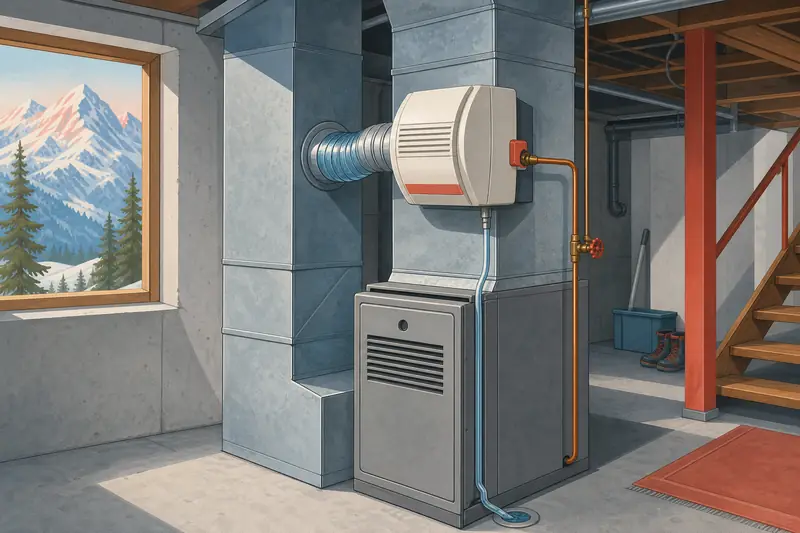
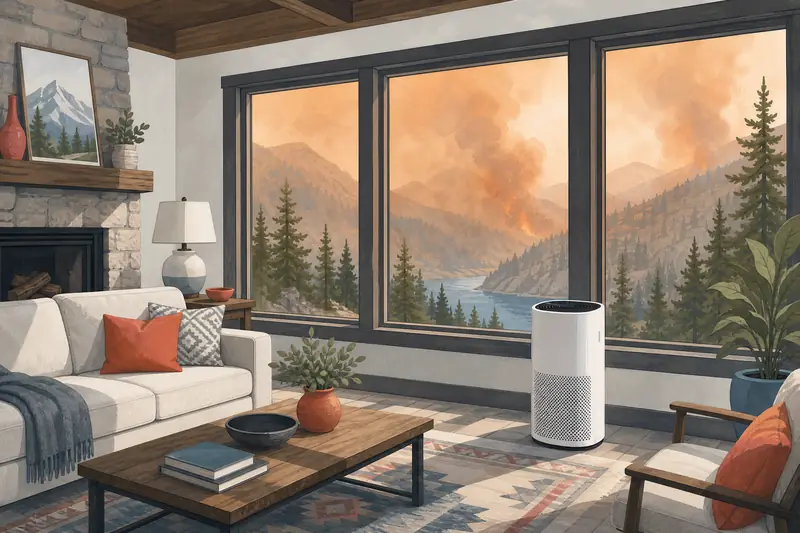
Close the house and filter what is inside: EPA and CDPHE both say to close outdoor air intakes or set systems to recirculate, run the furnace fan On, and use a MERV 13 filter. EPA's wildfire indoor air page adds portable air cleaners sized by CADR and a clean room where people spend most of their time.
Portable cleaners are sized by room area: EPA's table runs from 65 cfm of smoke CADR for 100 sq ft to 390 cfm for 600 sq ft, assuming 8-foot ceilings. AirNow's AQI turns Unhealthy for Sensitive Groups at 101 and Unhealthy at 151.
Where do carbon monoxide alarms go?
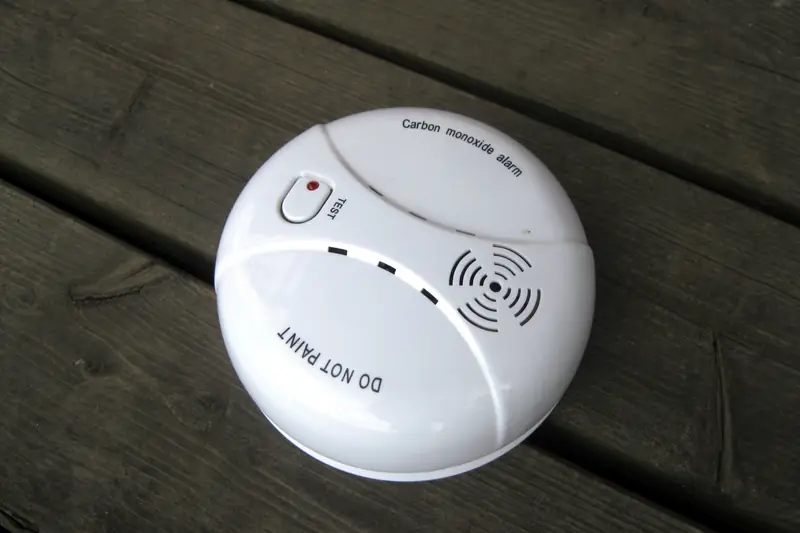
Put one outside each sleeping area and on every level: Colorado's 2009 law calls for an alarm within 15 feet of each sleeping room entrance in the cases it covers, and the CPSC advises one on every level as well. Every level is CPSC advice, not state law.
If an alarm sounds or anyone has symptoms, get everyone outside to fresh air, then call 911. If you smell gas, leave first and call Black Hills Energy from outside, without touching light switches, phones or flames indoors. Generators belong outdoors, at least 20 feet from windows, doors and vents.
Does a tight mountain home need an HRV or ERV?
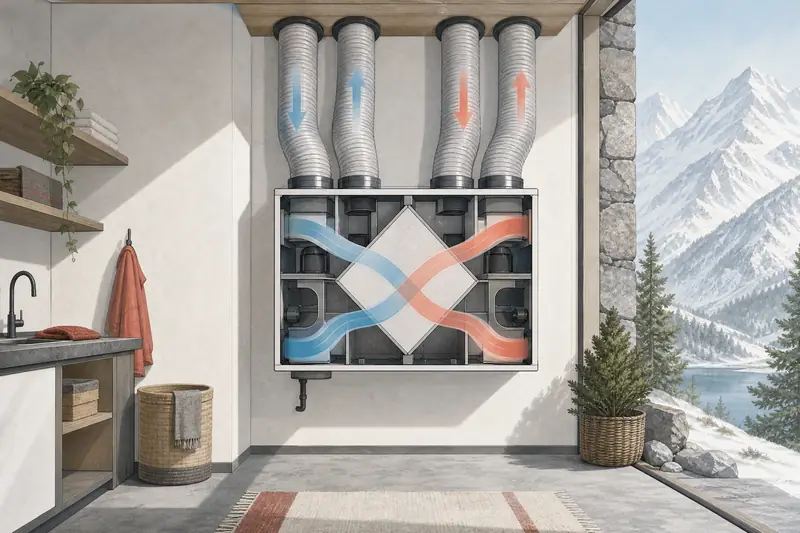
Usually yes: PNNL explains that airtight homes hold moisture and pollutants, and model codes call for mechanical ventilation once a house is built that tight. An HRV or ERV does that while recovering heat; by PNNL's figures, a typical ERV keeps roughly 70% to 80% of the outgoing sensible heat.
ASHRAE 62.2 sets the total rate at 0.03 cfm per square foot plus 7.5 cfm for each bedroom plus one. Ventilation can also help with radon in a basement, though EPA calls an HRV a secondary radon option and CDPHE says to test first.
How do humidity, smoke and ventilation interact?
They pull against each other, so plan them together: the fresh air that dilutes indoor pollutants is the same air EPA says to shut out during smoke, and in winter it is very dry. A household sets priorities by season.
| Season or event | Main concern | What the sources say to do |
|---|---|---|
| Deep winter | Dry air, frost in ventilator cores | Hold 30% to 50% humidity (EPA); Broan units defrost below 23°F |
| Wildfire smoke | Fine particles (PM2.5) | MERV 13, fan On, close outdoor intakes (EPA, CDPHE) |
| Heating season with gas appliances | Carbon monoxide | Alarms near sleeping rooms; yearly appliance service (CDC) |
| Tight house, all year | Stale air, moisture, radon | Ventilate to ASHRAE 62.2; test radon (CDPHE) |
An ERV keeps more indoor moisture than an HRV, per DOE, which helps in January. A humidifier should never push humidity past 50%, or the cold windows of a mountain house will run with water. And any home that burns gas needs its alarms no matter how well it is ventilated.
Indoor air numbers for valley homes
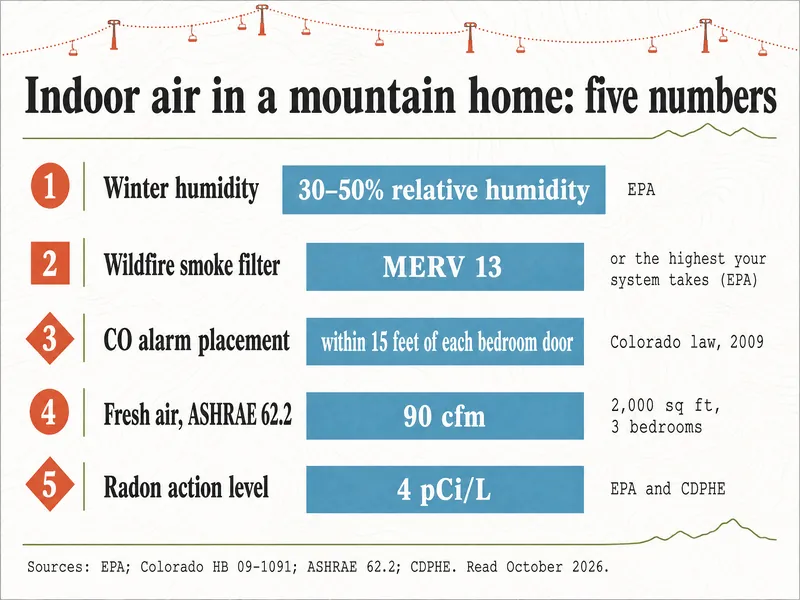
- 30–50%Indoor relative humidity EPA prefersEPA
- MERV 13Furnace filter rating for wildfire smokeEPA
- 15 feetColorado's alarm distance from sleeping rooms (2009 law)Colorado General Assembly
- 90 cfmASHRAE 62.2 total for 2,000 sq ft and 3 bedroomsASHRAE
- 1 in 2Colorado homes with elevated radonCDPHE
For the heating side of the same house, start with the six valley towns at a glance, then see why altitude changes heating and cold-snap steps for pipes and outages.
Avalanche report: how this page was checked
This hub summarizes the four indoor air pages on Upvalley Heat and the sources behind them: EPA's mold and moisture, humidifier, wildfire and air cleaner pages; CDPHE's wildfire smoke and radon pages; CPSC and CDC carbon monoxide pages; Colorado's 2009 carbon monoxide alarm law; DOE and PNNL ventilation pages; ASHRAE 62.2 Addendum m; Broan-NuTone's HRV/ERV owner's manual; and NOAA's Aspen 1SW climate normals (1991–2020), all read in October 2026. Left out: product rankings, health claims beyond what EPA, CDC and CDPHE state, and indoor humidity figures for any specific town.
Lift-line questions
Which indoor air job comes first in a new-to-you valley house?
Check for carbon monoxide alarms near every sleeping room and on each level, because that one protects life. Then test for radon with a CDPHE kit, check the furnace filter slot for a MERV 13 fit, and find out whether the house has an HRV or ERV.
Can one machine handle dry air, smoke and fresh air at once?
No single device does all three. A furnace filter handles smoke particles, a humidifier adds moisture, and an HRV or ERV brings in measured fresh air. They share ducts in many homes, which is why settings for one affect the others.
Is 30% humidity too low for a mountain home in January?
It is the bottom of EPA's 30% to 50% range, so it is acceptable. On very cold nights, window condensation may tell you that even 30% is the most your windows can take.
Do second homes need the same indoor air setup?
They need working CO alarms whenever anyone sleeps there, and an HRV with ducts in unheated space may need to keep running while the house is empty, per Broan's manual. During heavy smoke, EPA says filters need changing more often than the maker's schedule.
Does a ventilator bring wildfire smoke inside?
It can, since it pulls in outdoor air by design. EPA and CDPHE say to close outdoor intakes during smoke; check the unit's manual for how to lower or pause it safely.
Where can a valley household get a radon test kit?
CDPHE offers free radon test kits, one per household per year while supplies last. A test runs at least 48 hours with windows and doors closed.
Back to the base lodge: heating and cooling notes for the whole valley