Cold-Climate Heat Pumps for the Rockies
Cold-climate heat pumps are air-source models certified to keep a COP of at least 1.75 at 5°F; up here, also check output below zero, snow clearance and defrost drainage.
Written by the Upvalley Heat desk from manuals and official pages · how figures are sourced · Rechecked
Ownership note: Upvalley Heat belongs to the same ownership group as PlumbingSupplyAndMore, Central Plumbing & HVAC, SoftPro Water Systems and Quality Water Treatment, the businesses this page links to. Figures here come from federal, Colorado, county and utility pages and from manufacturers' installation manuals, read in October 2026. What a store says about its own products is the store's claim, not a finding of this site. How partner links work here
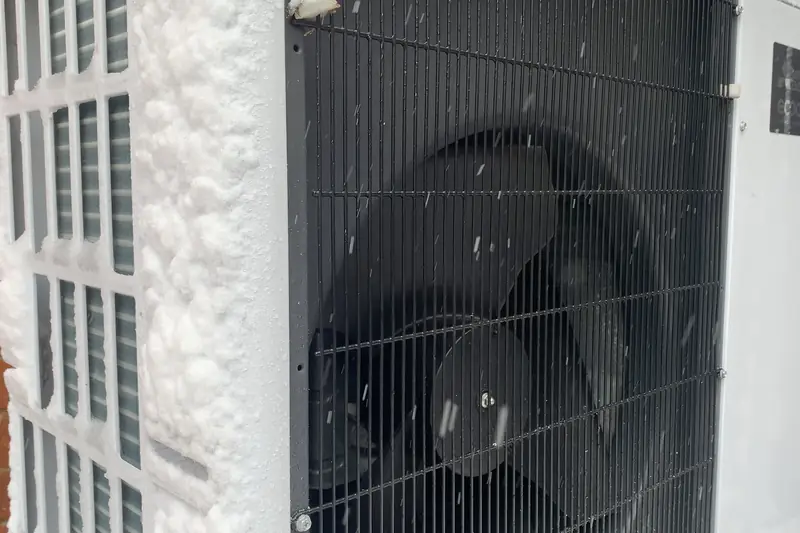
First tracks
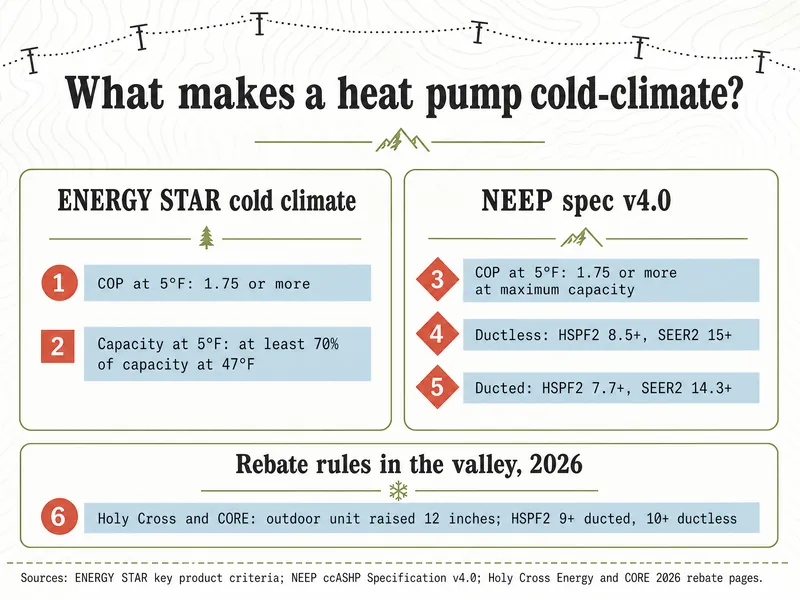
- ENERGY STAR's cold-climate label needs a COP of 1.75 or more at 5°F and 5°F capacity of at least 70% of the 47°F figure (ENERGY STAR criteria).
- NEEP's spec, version 4.0 since January 1, 2023, asks for the same 1.75 COP at 5°F at maximum capacity but sets no 70% capacity rule.
- At the Aspen 1SW weather station (about 8,175 ft), the January average low is 9.9°F (NOAA climate normals, 1991–2020).
- Holy Cross Energy and CORE both want the outdoor unit raised at least 12 inches for their 2026 heat pump rebates.
- Holy Cross asks for HSPF2 of 9 or more on ducted systems and 10 or more on ductless ones; it does not ask for a NEEP listing.
- One ducted cold-climate model, Bosch's IDS Ultra, ends a defrost when its coil reaches 64°F for one minute or after 8 minutes.
A cold-climate heat pump is an air-source heat pump built and tested to keep heating efficiently when the outdoor air drops into single digits. In the Roaring Fork Valley that matters more than in most of Colorado: every town sits between 5,762 feet (Glenwood Springs) and 8,208 feet (Snowmass Village), USGS elevation at each town's map point, and the long winters at the upper end are the hard case for any outdoor unit.
What makes a heat pump a cold-climate heat pump?
Two published yardsticks define the term, and they are not the same. ENERGY STAR's cold-climate criteria require a COP of at least 1.75 at 5°F, heating capacity at 5°F of at least 70% of capacity at 47°F, and a controls verification procedure. Its cold-climate efficiency floors are 8.5 HSPF2 and 15.2 SEER2 for ductless splits and 8.1 HSPF2 and 15.2 SEER2 for ducted splits.
The Northeast Energy Efficiency Partnerships (NEEP) specification, version 4.0, asks for COP 1.75 or more at 5°F when the unit runs at maximum capacity. Ductless systems need HSPF2 of 8.5 and SEER2 of 15; ducted systems need HSPF2 of 7.7 and SEER2 of 14.3. NEEP records capacity at 47°F, 17°F and 5°F but sets no capacity-ratio threshold, so the 70% figure belongs to ENERGY STAR alone.
| Program | COP at 5°F | Capacity rule | Ductless floor | Ducted floor |
|---|---|---|---|---|
| ENERGY STAR cold climate | 1.75 or more | 5°F capacity at least 70% of 47°F | 8.5 HSPF2, 15.2 SEER2 | 8.1 HSPF2, 15.2 SEER2 |
| NEEP ccASHP spec v4.0 (2023) | 1.75 or more at max capacity | None; capacities reported | 8.5 HSPF2, 15 SEER2 | 7.7 HSPF2, 14.3 SEER2 |
| Holy Cross Energy rebate, 2026 | Cold-climate unit required | Manual J load calculation | 10 HSPF2 or more | 9 HSPF2 or more |
| CORE rebate, 2026 | Rated to heat at −5° or lower | Heat pump is the primary heat | 10 HSPF2 or more | 9 HSPF2 or more |
How do cold-climate heat pumps perform at 5°F and below?
Output at 5°F and below depends on the model, so read the maker's extended-temperature table rather than the headline rating. The NOAA normals for Aspen 1SW put the January average low at 9.9°F, and the same station averages about 14 nights a year at or below 0°F, so the 5°F test point is a normal winter night up-valley, not an extreme.
Makers publish very different curves. Bosch says its ducted IDS Ultra gives 100% heating capacity at 5°F and keeps operating down to −13°F (Bosch product specification, January 2026). Mitsubishi's submittal for the 12,000 Btu/h MUZ-FS12NAH outdoor unit says it keeps its rated heating capacity down to −5°F and gives a maximum of 11,000 Btu/h at −13°F. Fujitsu describes its XLTH line as heating down to −15°F on its XLTH page; check the exact model's sheet, since a Fujitsu lineup page lists one XLTH wall unit at −5°F.
Altitude is a second, quieter factor. A Trane commercial catalog states that lower air density at elevation reduces condenser capacity and efficiency (Trane SS-PRC030L, 2021). No residential maker's figure for that loss was found, so ask the installer how the maker of the quoted unit handles elevation. The sizing side is covered in heat loss and sizing at elevation.
How do you read the NEEP list?
The NEEP product list is a lookup table of rated performance, not a sizing tool. It now runs on data makers report to AHRI, and NEEP notes that some eligible products have not yet been reported, so a missing model is not proof that it fails the spec.
When you open a listing, look past the 5°F COP. Compare maximum heating capacity at 5°F with your home's design heat loss, and check the minimum capacity at 47°F: a unit that can turn down low runs longer, steadier cycles in the shoulder seasons. NEEP itself warns that meeting its requirements "does not necessarily mean a product is appropriate for all applications."
Local rebates do not use the NEEP list as a test. Holy Cross Energy's 2026 residential rebate page (read October 2026) asks for a cold-climate unit, an AHRI number, HSPF2 of 9 or more for ducted systems and 10 or more for ductless, and a Manual J load calculation. CORE's 2026 rebates want a unit rated for cold climate at −5° or lower, as the primary heat source. Programs change; check before you buy, and see utility rebates in the Roaring Fork Valley for amounts and the pauses that apply in some towns.
How high should a cold-climate heat pump sit above snow?
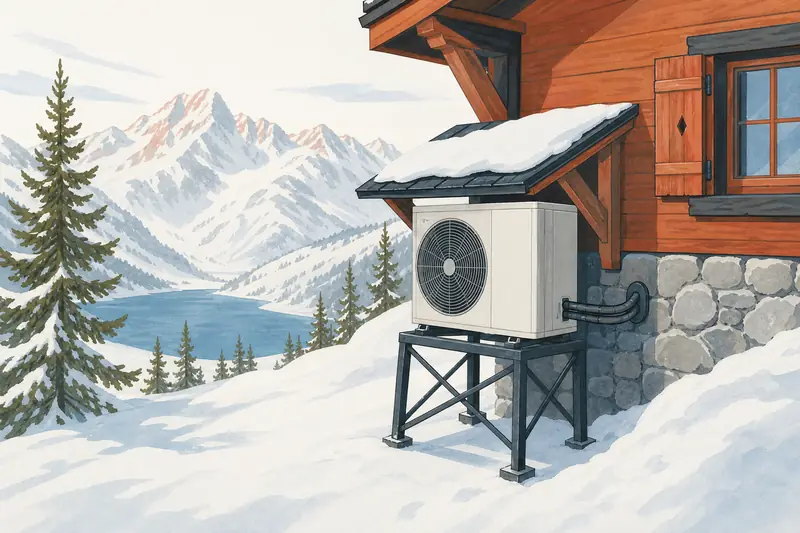
Plan on at least 12 inches above the ground, and higher where snow piles up. Holy Cross and CORE both require the outdoor unit to be raised 12 inches for their 2026 rebates; Holy Cross gives the reason as letting the unit defrost properly.
Manuals say the same in their own terms. Bosch's IDS Ultra installation manual (July 2026) calls for 3 to 12 inches above the pad depending on local weather so defrost meltwater can drain before it refreezes, a snow-drift barrier where drifting cannot be avoided, and a spot where roof snow or ice cannot fall on the unit. A Lennox heat pump manual says to raise the unit above the average snow line where snow lasts, and to keep it away from walkways so defrost water does not ice them.
Raising the unit is installer work. Stands, wall brackets and pads are the kind of parts a technician fits; PlumbingSupplyAndMore's condenser pads and mounting brackets (part of Upvalley Heat's ownership group) show what they look like. Your own job is lighter: brush snow off the top and coil with a soft brush or by hand, keep the area under the unit clear so meltwater drains, and never chip ice off the fins. If you are unsure, stop and call a qualified technician.
What does defrost do in a mountain winter?
Defrost briefly reverses the heat pump to melt frost off the outdoor coil, and it runs often in cold, humid weather. In Bosch's IDS Ultra, a demand-defrost control watches coil temperature, run time and pressure, and ends each cycle once the coil reaches 64°F for one minute or after 8 minutes. A base-pan heater switches on below 36°F so meltwater does not refreeze in the pan.
Two signs are normal: a cloud of steam from the outdoor unit and a short pause in warm air indoors. Mitsubishi's indoor units use a "Hot-Start" feature to avoid a cold-air rush after defrost. What is not normal is ice building up in a solid block around the base, which means meltwater has nowhere to go. That calls for a technician, and often a higher stand. See backup heat and dual fuel for what carries the house during defrost and the coldest nights.
Which numbers should you compare on quotes?
Ask every bidder for the same five figures, in writing, for the exact matched system. Matching matters: the Colorado heat pump tax credit requires an AHRI-matched, ENERGY STAR system designed to meet at least 80% of annual heating needs.
Quote checklist numbers
- 1.75Minimum COP at 5°F for ENERGY STAR and NEEP cold-climate unitsENERGY STAR
- 70%ENERGY STAR minimum share of 47°F capacity still delivered at 5°FENERGY STAR
- 9.9°FJanuary average low at Aspen 1SW, 1991–2020NOAA NCEI
- 12 inMinimum outdoor unit height for Holy Cross Energy's 2026 heat pump rebateHoly Cross Energy
The five figures: maximum heating capacity at 5°F (and at your coldest expected temperature, if the maker lists it); COP at 5°F; HSPF2 and SEER2 for the matched pair; the AHRI reference number; and the design heat loss from a Manual J calculation. A bid without a load calculation gives you nothing to compare the capacity against. Ask, too, how the outdoor unit will be raised and where defrost water will drain.
Avalanche report: how this page was checked
This page is based on ENERGY STAR's air-source heat pump criteria, NEEP's ccASHP Specification v4.0 (effective 2023) and product list notes, climate normals for the Aspen 1SW station (NOAA, 1991–2020), Bosch's IDS Ultra specification (January 2026) and installation manual (July 2026), Mitsubishi's MUZ-FS12NAH submittal (2023), Fujitsu's XLTH page, a Lennox heat pump manual, a Trane commercial catalog (2021), and the 2026 Holy Cross Energy and CORE rebate pages, all read October 2026. Left out: altitude derate percentages for home heat pumps (no residential maker figure was found), ASHRAE design temperatures, prices, and brand rankings.
Lift-line questions
Is a cold-climate heat pump enough on its own at 8,000 feet?
It can be, if its capacity at your coldest expected temperature covers the home's design heat loss. Many valley homes keep a backup, either electric strips or a gas furnace. A Manual J calculation and the maker's low-temperature table settle the question for a specific house.
Does Holy Cross Energy require a NEEP-listed heat pump?
No. Its 2026 page and worksheet ask for a cold-climate unit, an AHRI number, HSPF2 of 9 (ducted) or 10 (ductless), a Manual J and an outdoor unit raised 12 inches. Neither mentions NEEP.
Why does my heat pump blow steam in winter?
That is usually a defrost cycle melting frost off the outdoor coil. It should last minutes, not hours. Ice that keeps building in a solid mass under or around the unit needs a technician to look at drainage and height.
Can I knock ice off the outdoor coil?
Not with tools. Brush loose snow away by hand or with a soft brush and let defrost handle the rest. Chipping can bend fins or puncture the coil, which is refrigerant work that only an EPA Section 608 certified technician may do.
What is the difference between HSPF2 and COP at 5°F?
HSPF2 is the seasonal heating efficiency rating that federal minimums have used since January 1, 2023. COP at 5°F is a snapshot: heat delivered divided by electricity used at that one cold temperature. Up-valley, the 5°F figure tells you more about January.
Does the NEEP list tell me what size heat pump to buy?
No. NEEP says its list is not a sizing tool and that meeting the spec does not make a unit right for every home. Size comes from a room-by-room heat loss calculation compared with the unit's capacity at your design temperature.
Do cold-climate heat pumps qualify for the federal 25C credit in 2026?
No. The IRS says the 25C credit is not allowed for property placed in service after December 31, 2025. Colorado's own heat pump credit continues in 2026 through registered contractors; see heating tax credits in 2026.
More heat pump runs
Back to the base lodge: Roaring Fork Valley heating, town by town