Topic · 3 pages
Radiant Heat, Boilers and Snowmelt
Radiant heat in a valley home usually means warm water in floor tubing from a boiler or heat pump, and often a glycol snowmelt loop outside that Aspen and Pitkin County regulate closely.
Written by the Upvalley Heat desk from manuals and official pages · how figures are sourced · Rechecked
First tracks
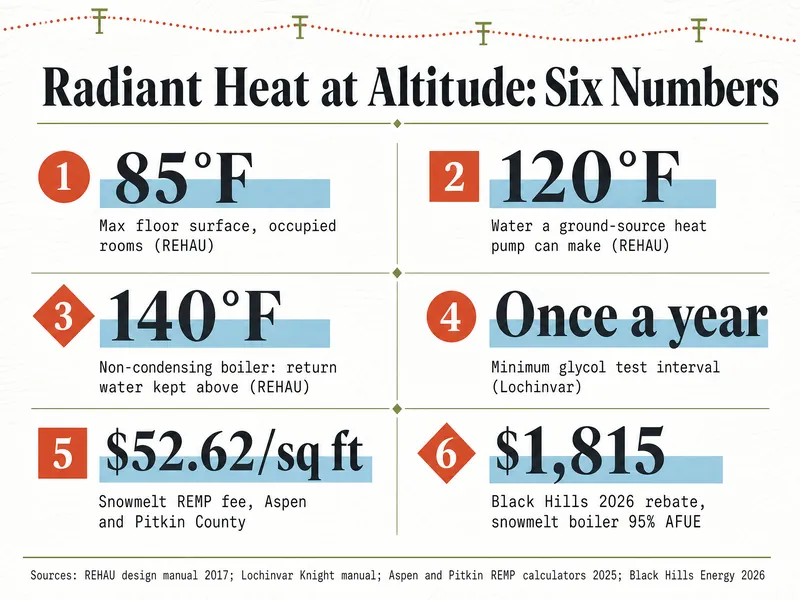
- REHAU's design manual (2017) puts the typical surface limit for floors people stand on at 85°F, so radiant heat runs on warm water, not hot.
- Ground-source heat pumps typically make water up to 120°F, which REHAU says suits many radiant floors.
- Lochinvar's Knight boiler manual calls for a yearly inspection by a qualified technician and a glycol test at least once a year.
- New residential snowmelt in Aspen and Pitkin County carries a REMP fee of $52.62 per square foot (2025 calculators).
- Snowmass Village uses its own 2011 offset schedule, not the Aspen and Pitkin fees.
- Black Hills Energy's 2026 gas rebates include $1,000 for a 95% AFUE boiler and $1,815 for a 95% AFUE hydronic driveway snowmelt boiler.
Radiant and snowmelt numbers
- 85°FREHAU's usual ceiling for floors in lived-in roomsREHAU design manual, 2017
- 120°FTop supply a geothermal water-to-water heat pump usually reachesREHAU design manual, 2017
- 8,880Heating degree days a year at the Aspen 1SW stationNOAA NCEI 1991–2020 normals
- $52.62Aspen and Pitkin County REMP charge for each square foot of new home snowmeltPitkin County REMP calculator 2025.1
- $1,815Black Hills Energy 2026 rebate for a 95% AFUE snowmelt boilerBlack Hills Energy 2026 rebate form
How does radiant heat work in a mountain home?
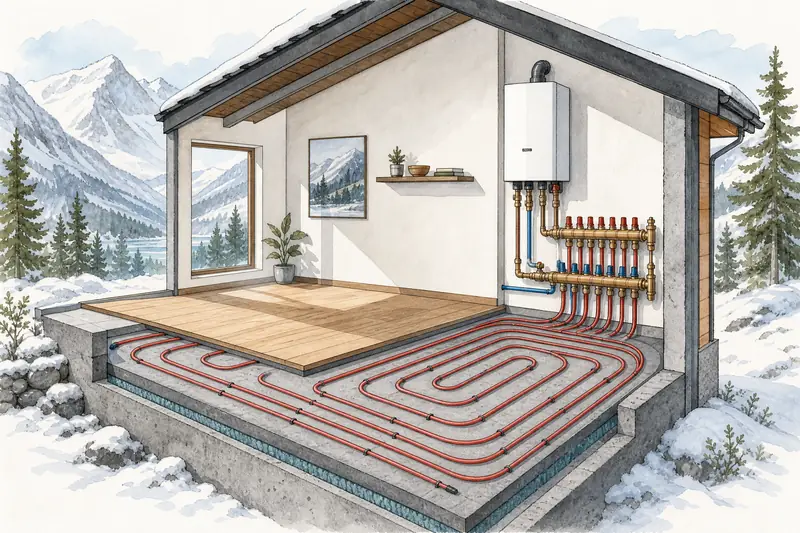
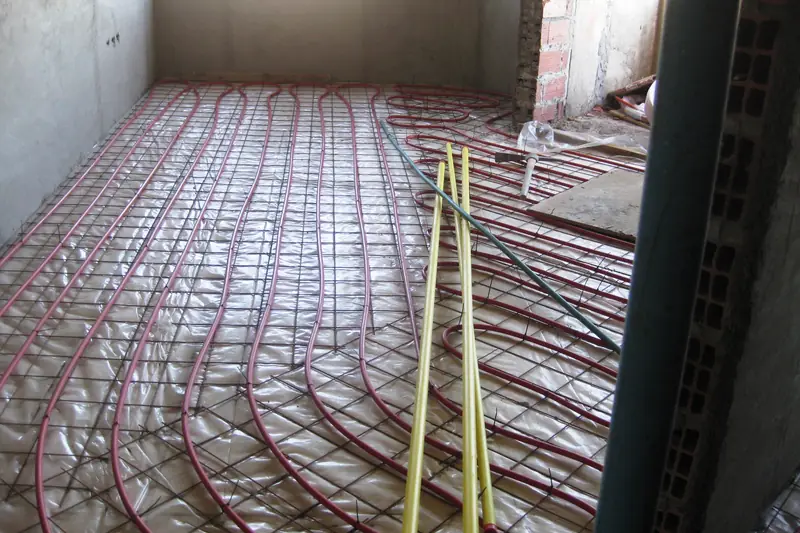
Radiant heat warms the floor, and the floor warms the people and the room; REHAU caps the surface at about 85°F in living areas. Tubing laid in a slab, a thin pour or panels carries water from a boiler or heat pump, and a manifold splits it into loops that can be zoned room by room.
It suits a long winter. At Aspen 1SW, a station near 8,175 feet, NOAA counts roughly 8,880 heating degree days a year (NOAA NCEI), and a heavy slab that holds a steady temperature through months of cold fits that pattern better than quick cycling. The trade-off is response time: REHAU's radiant heating design manual says high-mass slabs warm slowly from a cold start. The full picture, from water temperatures to tubing spacing, is in radiant floor heating.
| Heat source | What REHAU says |
|---|---|
| Condensing boiler | built to handle the cool return water radiant floors send back |
| Non-condensing boiler | needs mixing controls so return water stays above 140°F |
| Geothermal (water-to-water) heat pump | usually reaches 120°F supply, enough for many radiant systems |
| Electric boiler | compact, no flue, supply temperature set on the boiler |
| Solar thermal collectors | used with a storage tank, heat exchanger and mixing controls |
What care does a radiant boiler need?
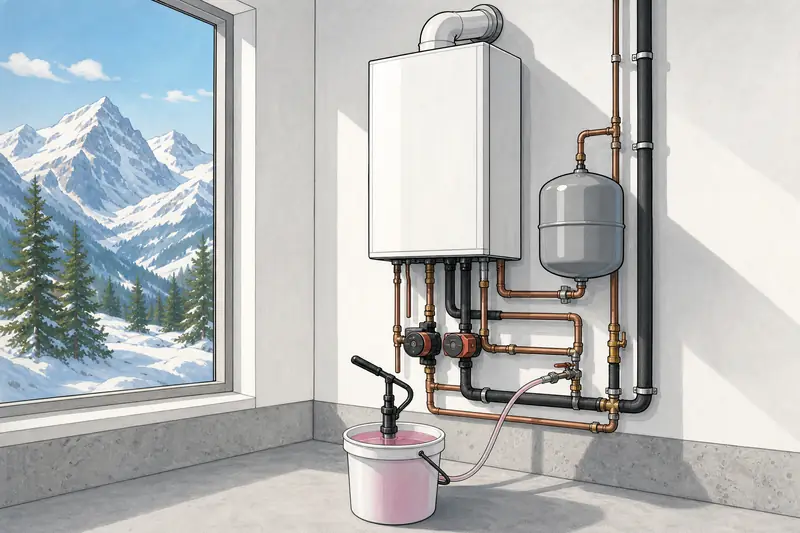
A radiant boiler needs a yearly inspection by a qualified technician, and Lochinvar's Knight manual adds a glycol test at least once a year wherever the loop holds antifreeze. The technician's list covers the condensate trap, leaks, flue and air pipes, system pressure and the expansion tank, controls, electrodes and the flame.
Two local details stand out. Pitkin County's building code, effective May 2, 2026, requires condensate from fuel-burning appliances to be neutralized before it drains. And because every valley town sits above the elevation where most makers call for high-altitude parts or settings, a replacement boiler needs the maker's altitude setup from the installer; see boilers and water heaters at high altitude. Owner checks, glycol and fill water are covered in boiler care and glycol.
How do snowmelt systems work?
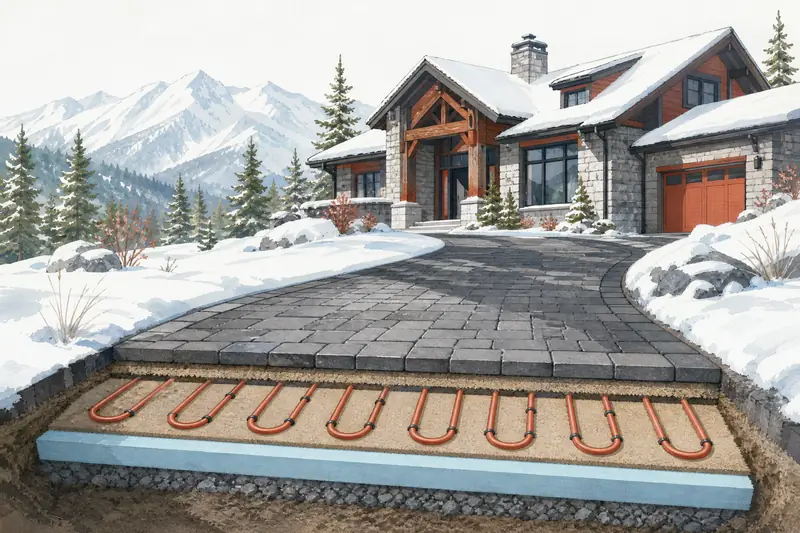
Snowmelt systems heat pavement from below, and Caleffi's idronics article rates home walks and drives at 80–125 Btu/hr per square foot (Class 1). At that rate a slab may need several hours to clear snow after starting cold, which is why controls and sensors matter so much.
Hydronic snowmelt usually runs on glycol, either throughout a dedicated system or behind a heat exchanger that keeps the house loop on plain water. Electric mats and cable are the other option. How the pieces fit, and how to keep the energy bill down, is in snowmelt systems.
What do local rules say about snowmelt?
Local rules make snowmelt one of the most regulated things a valley homeowner can build: Aspen and Pitkin County charge REMP fees of $52.62 for each square foot of new home snowmelt through their Renewable Energy Mitigation Programs and cap a property's exterior energy at 200,000,000 Btu a year. Each sets its own controls and insulation:
- City of Aspen: the 2021 Aspen Energy Code shuts snowmelt off when the surface is above 40°F and nothing is falling, and requires R-10 beneath it.
- Pitkin County: no idling of residential slabs, operation only with moisture present and air between 20°F and 40°F, slab sensing, R-15 insulation and heaters of 95% AFUE or better.
- Snowmass Village: its Renewable Energy Offset Program asks for a 50% renewable offset or a fee in lieu, which the 2011 ordinance figures at $34 per square foot divided by boiler efficiency. The Town's May 2026 code updates may have changed those numbers, so ask the Town.
REMP fees go into separate funds spent by resolution of the City Council and county commissioners. The remodel side, including permits and credits, is in Pitkin County REMP and the energy code.
Which radiant heat parts wear out first?
The parts that wear out first in a radiant heat system are the moving and consumable ones: circulator pumps, zone valves and actuators, glycol inhibitors, condensate neutralizer media and expansion tank air charges. Lochinvar says freeze-protection fluid must be replaced periodically as its inhibitors degrade, and that a sharp pressure rise during heating points to an expansion tank problem.
The tubing itself is rarely the weak point, with one exception REHAU flags: tubing that lacks an oxygen barrier admits oxygen, which then corrodes iron and steel pumps, valves and boilers. All of this is technician work; an owner's job is to watch the pressure gauge, note drips and book the yearly visit. Rebates for replacement equipment are listed under Roaring Fork Valley utility rebates; programs change, so check before you buy.
 Radiant and snowmelt: Radiant floor heating in mountain homes
 Radiant and snowmelt: Boiler care and glycol
 Radiant and snowmelt: Snowmelt systems: how they work and what they cost
 Upvalley Heat home
Avalanche report: how this page was checked
This hub draws on REHAU's Radiant Heating Systems design manual (2017), Lochinvar's Knight boiler manual (models 80–285), Caleffi's idronics article on heat exchanger applications (2021), Aspen 1SW climate normals (NOAA NCEI, 1991–2020), the Pitkin County and City of Aspen REMP calculators (2025 versions), Pitkin County Title 11 (May 2, 2026), the 2021 Aspen Energy Code, Snowmass Village's offset program web page and its 2011 ordinance, and Black Hills Energy's 2026 rebate form, all read October 2026. Left out: installed costs, supply-water ranges not stated by a maker, and glycol mix charts.
Lift-line questions
Is radiant heat common in Roaring Fork Valley homes?
No source checked for this site counts how many valley homes have it. Holy Cross Energy's 2026 heat pump worksheet does list in-floor gas and propane boilers among the system types it expects to see replaced.
Can radiant floors and snowmelt share one boiler?
They can. Caleffi describes systems where snowmelt is one of several loads on a common heat source, often separated by a heat exchanger so most of the system runs on water rather than antifreeze.
Do radiant systems need a permit to replace the boiler?
Expect one. Aspen's permit triggers and the Glenwood Springs building FAQ both call for a mechanical permit when heating equipment is swapped, and Pitkin County, Basalt and Carbondale post mechanical permit applications, so check with the building department first.
Does Holy Cross Energy pay anything toward radiant heat?
Its 2026 heat pump rebate covers air-to-water and split-hydronic heat pumps, which can feed radiant floors, at $3,500 per project ($7,000 income-qualified). It has no residential snowmelt rebate.
Why do radiant floors feel only lukewarm?
By design. REHAU's typical limit for occupied floors is 85°F, which is cooler than skin, so the floor feels mild while still heating the room.
Are snowmelt fees the same in Snowmass Village and Aspen?
No. Aspen and Pitkin County use the $52.62 per square foot REMP figure; Snowmass Village uses its own 2011 offset program, and its May 2026 code update may have changed the numbers.
Back to the base lodge: the Upvalley Heat home page and its six topics