Boiler Care and Glycol
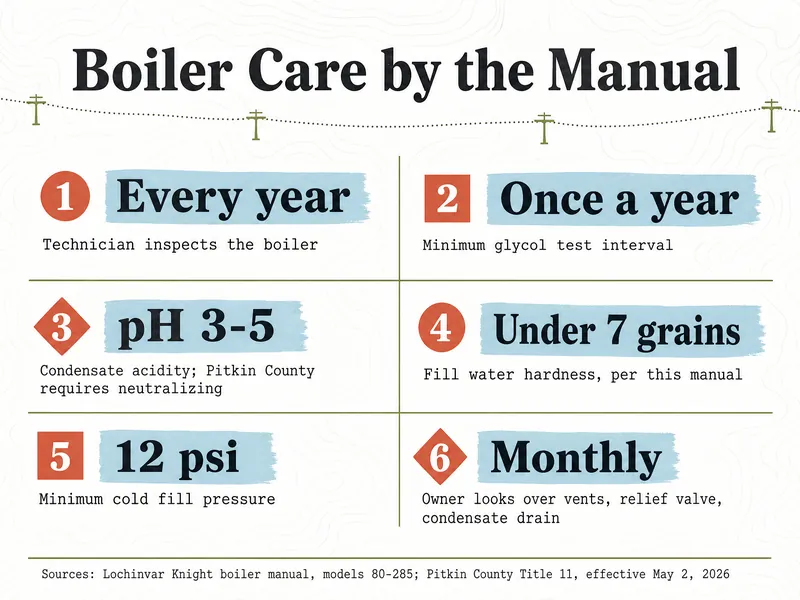
Boiler care means a yearly inspection by a qualified technician plus a few owner checks; where the loop holds glycol, Lochinvar's manual says to test it at least once a year.
Written by the Upvalley Heat desk from manuals and official pages · how figures are sourced · Rechecked
Ownership note: Upvalley Heat belongs to the same ownership group as PlumbingSupplyAndMore, Central Plumbing & HVAC, SoftPro Water Systems and Quality Water Treatment, the businesses this page links to. Figures here come from federal, Colorado, county and utility pages and from manufacturers' installation manuals, read in October 2026. What a store says about its own products is the store's claim, not a finding of this site. How partner links work here
First tracks
- Lochinvar's Knight boiler manual says the boiler "should be inspected annually only by a qualified service technician" and lists the items in its Table 12A.
- Glycol in a heating loop should be tested at least once a year and replaced periodically, because its inhibitors break down (Lochinvar).
- Condensing boilers drain slightly acidic condensate, typically pH 3 to 5; Pitkin County's code requires all condensate from fuel-burning appliances to be neutralized.
- The Knight manual asks for fill water under 7 grains of hardness; the City of Aspen describes its water as "very hard" at 130–300 ppm (8–17 grains).
- Black Hills Energy's 2026 Colorado rebates include up to $125 for a boiler tune-up every 2 years; applications are due January 31, 2027.
- A safety relief valve should be re-inspected at least once every three years by a licensed plumbing contractor or inspection agency, not the owner (Lochinvar).
Boiler care numbers
- pH 3–5Typical acidity of Knight boiler condensateLochinvar Knight manual
- 7 grainsFill-water hardness ceiling in the Knight manualLochinvar Knight manual
- 12 psiMinimum cold fill pressure for a Knight boilerLochinvar Knight manual
- 130–300 ppmSeasonal hardness range of City of Aspen waterCity of Aspen water FAQ
- $125Black Hills boiler tune-up rebate, once every 2 years (2026)Black Hills Energy
What does a yearly boiler care visit cover?
A yearly boiler care visit covers cleaning, leak checks, venting, water pressure, controls and the flame, all done by a qualified technician. Lochinvar's Knight Installation and Operation Manual for models 80–285 lists these service items in Table 12A:
- clean the condensate trap and refill it with fresh water;
- check for water, gas, flue and condensate leaks;
- confirm the flue and air pipes are sealed and in good shape;
- check system water pressure, piping and the expansion tank;
- check control settings, wiring and connections;
- clean and reposition the ignition and flame-sense electrodes and inspect the flame;
- clean the heat exchanger if the flue temperature runs more than 54°F above the return water temperature.
Other makers' lists differ, so the technician follows the manual for your model, including its high-altitude setup. CDC also advises having gas, oil and coal-burning heating appliances serviced by a qualified technician every year. Black Hills Energy's 2026 residential rebate form (read October 2026) pays up to $125 toward a boiler tune-up every 2 years for its Colorado gas customers; programs change, so check before you book the work.
Condensate is part of the visit. Lochinvar says the Knight's condensate is "slightly acidic (typically with a pH from 3 to 5)" and calls for a neutralizing filter where local codes require one. Pitkin County's Title 11 (effective May 2, 2026) does: all condensate from fuel-burning appliances must be neutralized before discharge. The neutralizer's media gets used up, so ask the technician to check it.
Why do some radiant systems use glycol?
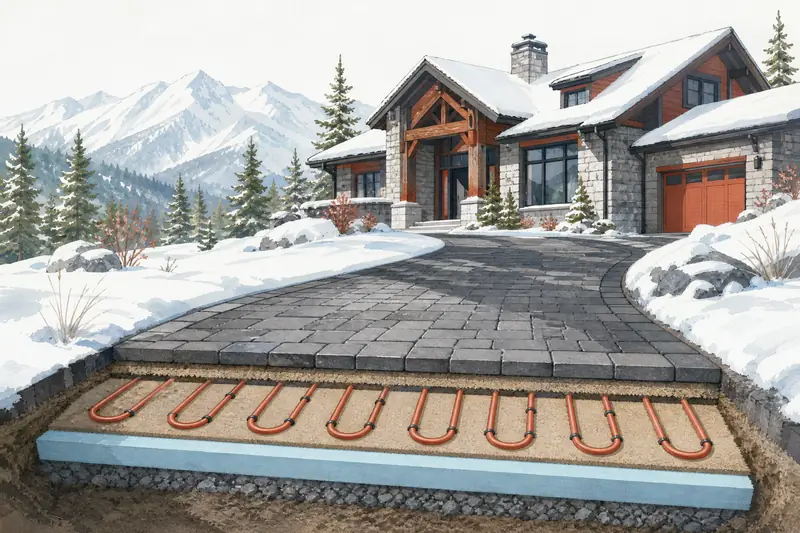
Some radiant systems use glycol because part of the loop can freeze: snowmelt slabs, garages, and homes left empty for weeks. Caleffi's idronics article on heat exchanger applications (2021) explains that snowmelt-only systems often run entirely on antifreeze, while combined systems often put a heat exchanger between the snowmelt loop and the house, so most of the system runs on plain water.
The type matters. Lochinvar's manual says "NEVER use automotive antifreeze" and allows only inhibited propylene glycol made for hydronic systems, warning that ethylene glycol is toxic and can attack gaskets and seals. Dow's product page says DOWFROST inhibited propylene glycol solutions give freeze protection below −60°F; the right strength for your loop comes from the glycol maker's tables and the system designer, not a one-size chart. With an Aspen 1SW January average low of 9.9°F (NOAA NCEI 1991–2020 normals), a loop that loses circulation in a power outage can freeze in a cold spell; see heat during power outages.
How often should glycol be tested?
Glycol should be tested at least once a year and as often as the glycol maker recommends, according to Lochinvar's Knight manual. The same manual says freeze-protection fluid "must be replaced periodically due to degradation of inhibitors over time."
Leaks change the mix. Lochinvar notes that glycol may leak before water does, which lowers the concentration and the freeze protection, and that systems with automatic fill should have a water meter to show make-up water. Local codes may also require a backflow preventer, or a full disconnect from city water, on glycol systems. A technician tests freeze point and inhibitor level, then adds or replaces fluid; the amount has to include the expansion tank's water content.
What does the expansion tank do?
The expansion tank gives heating water room to grow as it warms and shrink as it cools, which keeps system pressure steady. Lochinvar describes tanks as open, closed, diaphragm or bladder types, and the Knight manual sets a minimum cold fill pressure of 12 psi.
A tank that has lost its air charge or is too small shows up as pressure that climbs sharply as the boiler heats. Lochinvar says that kind of rise "indicates expansion tank sizing or performance problem," and that a weeping relief valve may be caused by a waterlogged or undersized tank rather than a bad valve. PlumbingSupplyAndMore's hydronic expansion tanks (part of Upvalley Heat's ownership group) show the sizes and types a technician chooses from; checking the charge and replacing a tank are technician jobs.
| Task | How often | Who |
|---|---|---|
| Full inspection per Table 12A | Every year | Qualified technician |
| Glycol freeze point and inhibitor test | At least once a year | Technician |
| Relief valve re-inspection | At least every three years | Licensed plumbing contractor or inspection agency |
| Pressure and temperature gauge | Daily glance | Owner |
| Vent and air terminations, condensate drain | Monthly look | Owner |
| Condensate neutralizing | Required in Pitkin County | Installer sets up; technician checks |
Does water hardness matter for boiler care?
Water hardness matters on both sides of a boiler, but the two sides follow different rules. For the sealed loop that feeds radiant floors, Lochinvar's Knight manual asks for fill water under 7 grains of hardness and chlorine under 200 ppm, and tells installers in harder-water areas to consult local water treatment companies. Boiler fill water follows the boiler's own manual; no maker document checked for this page says anything about softened fill water.
Valley water varies. The City of Aspen's water FAQ calls its supply "very hard," 130–300 ppm (8–17 grains per gallon), changing with the season. Snowmass Water & Sanitation's 2025 report shows 74–104 ppm. Glenwood Springs, Carbondale and Basalt publish no hardness figure.
The domestic side is where hard water does most of its damage: scale builds in water heaters and in the hot-water side of combi boilers and indirect tanks. A softener such as SoftPro's Elite water softener (part of Upvalley Heat's ownership group) or a salt-free conditioner (part of Upvalley Heat's ownership group) at Quality Water Treatment is one way owners handle scale on that domestic water. Ask the boiler installer how the fill line is piped before treating it.
What can a homeowner check between visits?
A homeowner can look, listen and note, but leave the opening and adjusting to a technician. Lochinvar's owner list includes a daily look at the boiler area and its pressure and temperature gauge, and a monthly check of vent and air piping, the outdoor termination screens, the relief valve, the condensate drain and the air vents. If you are unsure what a reading means, stop there and call a qualified technician.
- Snow at the vents. Furnace makers set vent terminations at least 12 inches above the expected snow level, and each boiler manual sets its own clearances. After a storm, clear drifts from the outside pipes by hand or with a soft brush; if exhaust keeps icing or the boiler keeps locking out, call a technician.
- Drips. Water under the relief valve discharge pipe, at the manifold or around the tank is worth a service call, not a tightened fitting.
- Do not lift the relief valve lever yourself. Lochinvar warns of scalding water; operating and re-inspecting it is technician or inspection-agency work.
A boiler burns gas, so carbon monoxide rules apply. Colorado's 2009 law requires CO alarms within 15 feet of the entrance to each sleeping room in the homes it covers, including when a fuel-fired appliance is replaced under a permit; CPSC also advises one on every level. If an alarm sounds or anyone feels ill, get everyone outside to fresh air, then call 911. If you smell gas, leave first and call Black Hills Energy from outside; do not flip switches or use a phone indoors (Black Hills Energy). More in carbon monoxide safety.
Avalanche report: how this page was checked
This page is based on the Knight boiler manual from Lochinvar (models 80–285; sections 6, 9, 10 and 12, Table 12A), Caleffi's idronics article on heat exchanger applications (July 2021), Dow's DOWFROST product page, Pitkin County Title 11 (effective May 2, 2026), the City of Aspen water FAQ, Snowmass Water & Sanitation's report for calendar 2025, the 2026 Black Hills Energy residential rebate application for Colorado, CDC and CPSC carbon monoxide pages and Colorado's 2009 CO alarm law, all read October 2026. Left out: glycol percentage-by-temperature charts (Dow's engineering tables could not be opened), pH or chloride limits for other boiler brands whose manuals were not opened, and any maker statement on softened fill water, because none was found.
Lift-line questions
Can automotive antifreeze go in a boiler loop?
No. Lochinvar's manual says never to use automotive antifreeze and to use only inhibited propylene glycol made for hydronic systems. Ethylene glycol is toxic and can attack gaskets and seals.
Why did my glycol test show weaker protection than last year?
Lochinvar notes that glycol can leak out before water does, and automatic fill then tops the loop up with plain water, diluting it. A water meter on the fill line shows how much make-up water went in, and a technician can restore the mix.
Does a combi boiler need different care than a heat-only boiler?
The heating side gets the same yearly inspection, but a combi also heats domestic water, so hard water can scale its hot-water side. Treating the domestic supply is one way owners handle that; the heating loop's fill water still follows the boiler manual.
Where does boiler condensate go in Pitkin County?
Through a neutralizer first. Pitkin County's Title 11 requires all condensate from fuel-burning appliances to be neutralized before it reaches a fixture or disposal area, and the neutralizer media needs checking at service visits.
Is a dripping relief valve a valve problem or a tank problem?
It can be either. Lochinvar says to make sure weeping comes from the valve itself and not from over-pressure caused by a waterlogged or undersized expansion tank. A technician checks the tank charge and pressure before replacing the valve.
How often does a boiler qualify for a Black Hills tune-up rebate?
Black Hills Energy's 2026 Colorado form lists up to $125 for a boiler tune-up every 2 years, for customers whose main heating fuel is Black Hills gas. Applications for 2026 work are due January 31, 2027.
Does a boiler need anything special at valley elevations?
Yes: most gas boilers need the maker's high-altitude parts or settings at 5,762 feet and up (the USGS elevation at Glenwood Springs' map point), set by the installer. Details are in boilers and water heaters at high altitude.
Next runs
Back to the base lodge: Roaring Fork Valley heating, town by town