Humidifiers for Dry Mountain Air
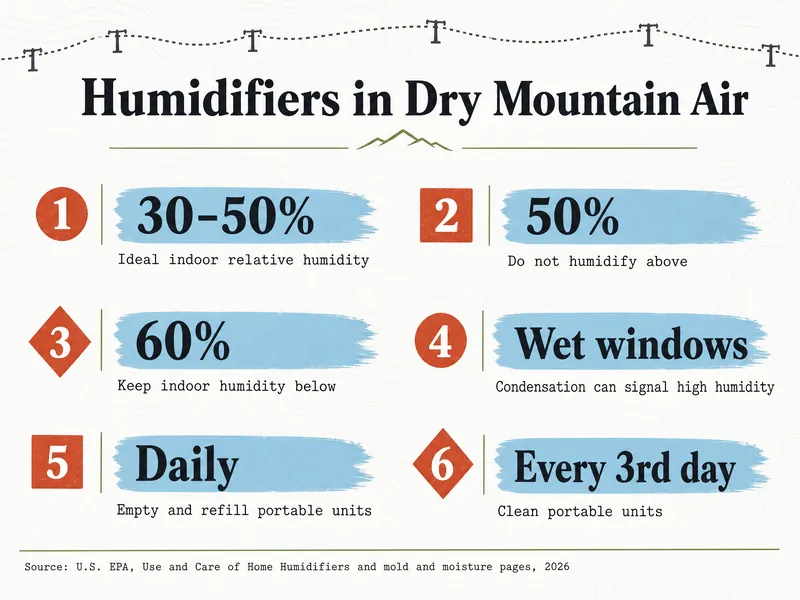
Humidifiers should hold a mountain home between 30% and 50% relative humidity, EPA's ideal range, and never above 50%; cold windows usually set the real limit long before that.
Written by the Upvalley Heat desk from manuals and official pages · how figures are sourced · Rechecked
Ownership note: Upvalley Heat belongs to the same ownership group as PlumbingSupplyAndMore, Central Plumbing & HVAC, SoftPro Water Systems and Quality Water Treatment, the businesses this page links to. Figures here come from federal, Colorado, county and utility pages and from manufacturers' installation manuals, read in October 2026. What a store says about its own products is the store's claim, not a finding of this site. How partner links work here
First tracks
- EPA advises keeping indoor relative humidity below 60%, ideally between 30% and 50%, and not humidifying above 50%.
- If water condenses on windows, walls or pictures, EPA says to move the humidifier, lower its setting or run it less.
- Ultrasonic and impeller humidifiers disperse the most minerals and microbes; EPA calls distilled water the most effective low-mineral option.
- EPA's routine for portable units: empty, wipe dry and refill daily, and clean every third day.
- Aprilaire's bypass and fan-powered humidifiers use about 1–2 gallons of water an hour and need hot water when installed with a heat pump.
- The City of Aspen calls its tap water "very hard," at 130–300 ppm, which matters for white dust and scale.
Humidity numbers
- 30–50%EPA's ideal indoor relative humidityU.S. EPA
- 50%Humidity EPA says not to exceed when humidifyingU.S. EPA
- 9.9°FJanuary average low at Aspen 1SWNOAA NCEI 1991–2020
- 1–2 gal/hrWater use of Aprilaire 500, 600 and 700 humidifiersAprilaire
- 3%Hydrogen peroxide strength EPA suggests when the maker names no cleanerU.S. EPA
How humid should a mountain home be in winter?
A mountain home should sit between 30% and 50% relative humidity in winter, and below 60% at all times, according to EPA's mold and moisture page. EPA's humidifier use and care page adds a firmer ceiling for anyone running a humidifier: "Do not humidify to indoor relative humidity levels exceeding 50 percent."
The air up here starts out dry for a simple reason: it is cold for a long time. NOAA's 1991–2020 normals for the Aspen 1SW station (about 8,175 feet) show a January average low of 9.9°F and roughly 8,880 heating degree days a year (NCEI). Cold outdoor air holds little water, and once it leaks in and warms to room temperature its relative humidity falls sharply.
Measure before you add moisture. EPA notes that hygrometers from hardware stores read relative humidity, and some humidifiers have a built-in humidistat. A reading in the low 30s on a January evening is already inside EPA's range.
Why do windows limit how much you can humidify?
Windows limit humidifying because the glass is the coldest surface in the room, so moisture condenses there first. EPA treats condensation as a sign of high humidity and says that if water condenses on windows, walls or pictures, you should relocate the humidifier, lower its humidistat or reduce its use.
On a below-zero night, that point can come well under 50%. Aprilaire, a maker of whole-house humidifiers, builds this into its automatic controls: an outdoor temperature sensor continuously reports to the humidifier control, which uses the reading to decide how much humidity the home needs. Its owner FAQ also says outdoor temperature, home age and tightness affect what humidity level is attainable. A manual humidistat does none of this, so on the coldest nights you turn it down yourself.
Wet sills matter beyond the view. EPA links indoor moisture to mold growth and asks owners to dry wet surfaces quickly and reduce the moisture source.
How do whole-house humidifiers work?
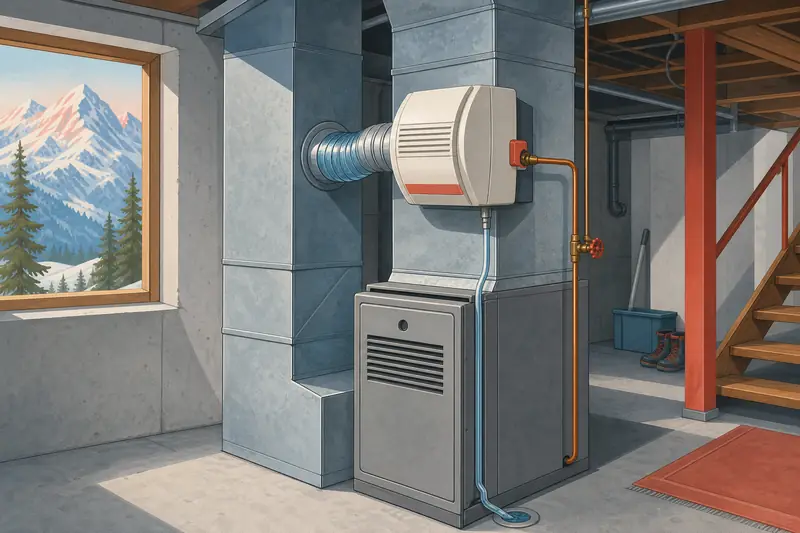
Whole-house humidifiers mount on the furnace or air handler ductwork and add moisture to air the system already moves. Aprilaire's owner FAQ describes three styles: bypass models (its 500 and 600) that route warm air through a wetted water panel, a fan-powered model (700) that pushes air through the panel with its own fan, and a steam model (800) that boils water.
Water supply depends on the style. Aprilaire prefers hot water for its evaporative units and requires it when the humidifier is connected to a heat pump, because a heat pump's supply air is cooler. Its humidifier FAQ says Models 500, 600 and 700 typically use 1–2 gallons an hour and do not draw enough to trigger a tankless water heater, so it recommends plumbing them to a standard tank water heater. The steam model takes cold water.
| Type | Mineral dispersal (EPA) | Water | Upkeep |
|---|---|---|---|
| Ultrasonic (portable) | among the highest | low-mineral, distilled best | empty and refill daily; clean every third day |
| Impeller, "cool mist" (portable) | among the highest | low-mineral, distilled best | empty and refill daily; clean every third day |
| Steam vaporizer (portable) | not expected to be substantial | per maker | daily refill; keep away from children (burn risk) |
| Bypass or fan-powered evaporative (whole-house) | not expected to be substantial | hot preferred; soft or softened for best performance (Aprilaire) | water panel once a year on Aprilaire 500, 600 and 700 |
| Steam (whole-house) | not expected to be substantial | cold (Aprilaire 800) | canister and O-ring yearly; electrode wires every three years by a contractor |
A whole-house unit is installed by an HVAC technician because it involves cutting into ductwork, a water line, a drain and low-voltage wiring. PlumbingSupplyAndMore's humidifier category (part of Upvalley Heat's ownership group) shows the bypass, fan-powered and steam units a technician chooses from. Aprilaire also recommends soft or softened water for its evaporative units and notes hard water increases scale and maintenance.
What water should a portable humidifier use?
A portable ultrasonic or impeller humidifier should use low-mineral water; EPA calls bottled water labeled "distilled" the most effective choice. EPA explains that these "cool mist" units are very efficient at throwing tap-water minerals into the air, which can settle as a "white dust," and that scale in the tank can become a breeding ground for microorganisms.
That matters in hard-water towns. The City of Aspen's water FAQ calls its supply "very hard," 130–300 ppm (8–17 grains per gallon), varying with the season, and Snowmass Water & Sanitation reports 74–104 ppm for 2025. EPA also notes that bottled water labeled "spring," "artesian" or "mineral" has not been demineralized.
EPA lists deionization and reverse osmosis as processes that remove most minerals, though generally less completely than distillation. An under-sink reverse osmosis system, such as the Waterdrop G3P600 sold by SoftPro (part of Upvalley Heat's ownership group), is one source of low-mineral water for refilling an ultrasonic unit; watch for white dust, which EPA says signals that minerals are still getting through. Steam and evaporative units are not expected to disperse much mineral, per EPA.
How do you keep humidifiers clean?
You keep a portable humidifier clean by emptying, wiping dry and refilling it every day and scrubbing it every third day, the routine EPA gives for portable units. Unplug it first, brush out scale and film, and follow the maker's directions on cleaners; where the maker gives none, EPA suggests a 3% hydrogen peroxide solution, then several rinses so no chemical goes into the air.
For furnace-mounted units, follow the maker's schedule. Aprilaire's maintenance page calls for a new water panel once a year on Models 300, 500, 600, 700 and 720 and twice per heating season on Model 400; steam canisters and O-rings are replaced yearly. Follow the manual's shutdown steps for power and water before opening the cover, and if the unit is wired or plumbed in a way you do not recognize, stop and leave it to a qualified technician.
At the end of the season, EPA says to clean the unit, dry every part, discard used demineralization cartridges and store it somewhere dry. Do not let carpets, drapes or tablecloths near a humidifier get damp.
When is a humidifier the wrong fix?
A humidifier is the wrong fix when the home already reads 30% or higher, when windows or walls are already wet, or when the real complaint is smoke or stale air. In those cases more water vapor adds mold risk without solving the problem.
- Windows already sweating: lower the setting, as EPA advises, and look at ventilation.
- Smoky air in fire season: a humidifier does not filter particles; see wildfire smoke filtration.
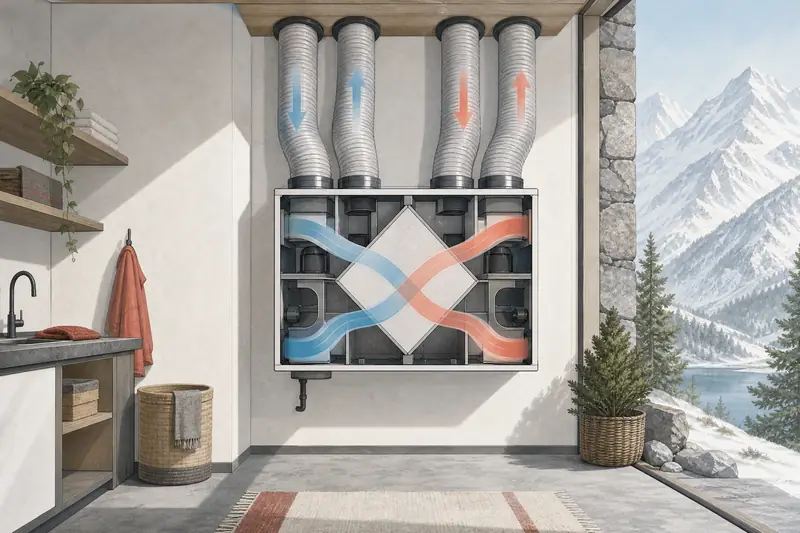
- Stuffy, tight house: the Department of Energy notes that energy recovery ventilators move some water vapor along with heat, which helps indoor humidity stay steadier; see HRV and ERV ventilation.
- Musty smell or visible mold: EPA's advice is to fix the moisture source, not add more.
The indoor air section covers the other parts of winter air quality in a mountain home, and heat loss and sizing at elevation covers how a mountain house loses its heat.
Avalanche report: how this page was checked
This page is based on EPA's "Use and Care of Home Humidifiers" (updated April 29, 2026) and its mold and moisture page (updated February 18, 2026), Aprilaire's owner FAQ, humidifier FAQ and maintenance page, NOAA NCEI 1991–2020 normals for Aspen 1SW, hardness figures from the City of Aspen's FAQ and the 2025 Snowmass Water & Sanitation report, and the Department of Energy's energy recovery ventilation page, all read October 2026. Left out: health claims beyond EPA's wording, brand comparisons, and Honeywell or other makers' manuals, which were not opened.
Lift-line questions
Is 25% humidity too low for a house in Aspen in January?
It sits below EPA's ideal 30–50% band. Before raising it, check the windows on the coldest night; if they fog or frost at a higher setting, the glass is the limit and a lower reading may be the practical choice.
Can tap water go in an ultrasonic humidifier in the valley?
EPA recommends low-mineral water, with distilled the most effective, because these units spray tap-water minerals into the air as white dust. With City of Aspen water reported at 130–300 ppm hardness, tap water is likely to leave dust and scale.
Does reverse osmosis water work in a humidifier?
EPA says reverse osmosis removes most minerals, though usually less completely than distillation. If white dust still appears, minerals are getting through and distilled water is the better choice.
Why does a whole-house humidifier need hot water with a heat pump?
Aprilaire says hot water is required on heat pump systems because the air leaving a heat pump is cooler, so the water itself has to supply the heat for evaporation.
How often should the pad in a furnace humidifier be changed?
Aprilaire's schedule is once a year for its Models 300, 500, 600, 700 and 720 and twice per heating season for Model 400. Other brands set their own intervals in their manuals.
What is the white dust on furniture near my humidifier?
EPA describes it as minerals from tap water thrown into the air, mostly by ultrasonic and impeller units. Switching to distilled or demineralized water, or to an evaporative or steam unit, cuts it down.
Should a steam vaporizer be used in a child's room?
EPA says to keep steam vaporizer humidifiers out of the reach of children, because steam and boiling water can cause burns.
Next runs


Back to the base lodge: the valley elevation profile and topic list