Boilers and Water Heaters at High Altitude
Boilers and water heaters at high altitude burn less gas than their sea-level rating, through a kit, a control setting or a factory high-altitude model; which one depends on the maker's manual.
Written by the Upvalley Heat desk from manuals and official pages · how figures are sourced · Rechecked
Ownership note: Upvalley Heat belongs to the same ownership group as PlumbingSupplyAndMore, Central Plumbing & HVAC, SoftPro Water Systems and Quality Water Treatment, the businesses this page links to. Figures here come from federal, Colorado, county and utility pages and from manufacturers' installation manuals, read in October 2026. What a store says about its own products is the store's claim, not a finding of this site. How partner links work here
First tracks
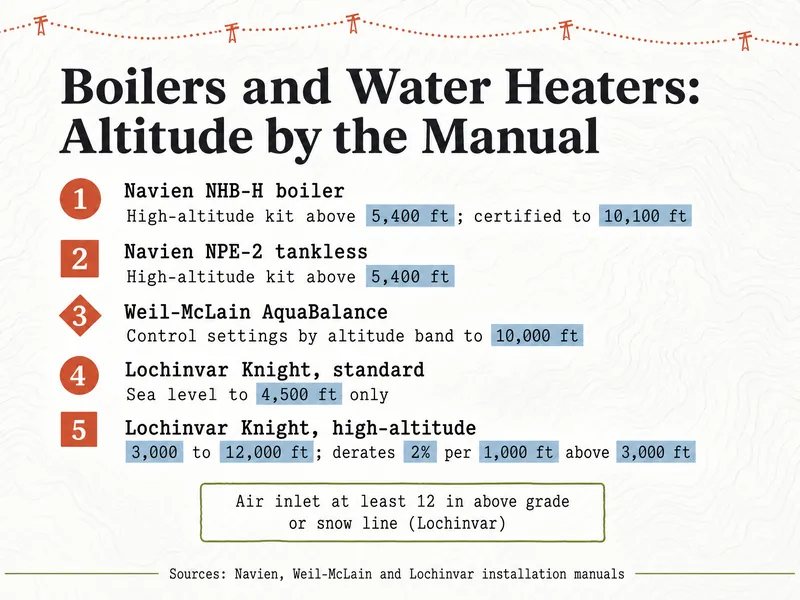
- Weil-McLain's AquaBalance addendum (2017) derates input 4% for each 1,000 feet above sea level beyond 2,000 feet, per the National Fuel Gas Code, using control settings to 10,000 feet.
- Navien's NHB-H boiler and NPE-2 tankless water heater both need the high-altitude conversion kit above 5,400 feet, which covers all six valley towns (USGS elevations 5,762 to 8,208 feet).
- Lochinvar's Knight manual rates standard boilers from sea level to 4,500 feet only; its high-altitude models run from 3,000 to 12,000 feet and derate 2% per 1,000 feet above 3,000.
- Lochinvar wants the boiler's air inlet at least 12 inches above grade or the snow line, and says output can drop up to 1.5% for each 25 feet of vent.
- Black Hills Energy's 2026 gas rebates pay $675 or $1,000 for boilers at 90% or 95% AFUE and $400 for a tankless water heater at 0.87 UEF or better; applications are due January 31, 2027.
- Altitude setup is installer-only. Navien warns that the wrong altitude setting "could cause carbon monoxide poisoning."
How do boilers and water heaters handle high altitude?
Boilers and water heaters handle high altitude the same way furnaces do: their gas input is reduced so the burner has enough oxygen to burn cleanly in thin air. The method is what varies. Weil-McLain changes blower-speed parameters, Navien fits a conversion kit and sets the altitude in the controls, and Lochinvar builds separate high-altitude Knight boilers with their own control module.
The starting rule is the one Weil-McLain prints in its AquaBalance high-altitude addendum: "Input rates are derated 4% for each 1000 ft. above sea level, beyond 2000 ft." Lochinvar's factory high-altitude Knight uses a smaller 2% per 1,000 feet above 3,000 feet, which shows why the model's manual, not a rule of thumb, sets the number.
From Basalt (6,608 feet at its USGS point) to Snowmass Village (8,208 feet), this is part of what makes the appliance safe, not optional tuning; the same principle drives furnace altitude derating.
Altitude limits from boiler and water heater manuals
- 5,400 ftAbove this, Navien NHB-H and NPE-2 need the high-altitude kitNavien conversion instructions
- 10,100 ftHighest certified install, Navien NHB-H boilerNavien conversion instructions
- 4,500 ftCeiling for a standard Lochinvar Knight boilerLochinvar Knight manual (2010)
- 12 inAir inlet above grade or snow lineLochinvar Knight manual (2010)
When does a boiler need a high-altitude kit?
A boiler needs a high-altitude kit when its manual says so for your elevation, and for some popular models that line falls below every town in the valley. Navien's NHB-H instructions say that above 5,400 feet the installer must "use the HIGH ALTITUDE CONVERSION KIT supplied with the boiler," and the boiler may be installed up to 10,100 feet on natural gas or propane.
The kit is only half the job. Navien's technician also sets circuit-board DIP switches for the altitude band (0 to 1,999, 2,000 to 5,399, 5,400 to 7,699 or 7,700 to 10,100 feet) and measures CO2 against the manual's table. Navien warns that a missing kit or wrong setting "could cause carbon monoxide poisoning, resulting in serious injury or death."
Other makers skip the kit. Weil-McLain's WMB-155C combi boiler is set for altitude by changing three blower-speed parameters, band by band up to 10,000 feet, then checking CO2 and CO; the addendum says it "must only be used by a qualified installer/service technician." Lochinvar's high-altitude Knight leaves the factory ready for 3,000 to 12,000 feet "with no field adjustments" and carries a high-altitude label, while a standard Knight is rated to 4,500 feet only.
| Appliance | How altitude is handled | Elevation range in the manual |
|---|---|---|
| Navien NHB-H condensing boiler | Conversion kit above 5,400 ft, DIP switches by band, CO2 check | Up to 10,100 ft |
| Navien NPE-2 tankless water heater | Conversion kit above 5,400 ft, altitude menu setting | Up to 10,100 ft |
| Weil-McLain AquaBalance WMB-155C combi | Blower-speed parameters by band, CO2 and CO check | Up to 10,000 ft |
| Lochinvar Knight, standard | No adjustments; derates 4% per 1,000 ft | Sea level to 4,500 ft only |
| Lochinvar Knight, high-altitude model | Factory control module; derates 2% per 1,000 ft above 3,000 ft | 3,000 to 12,000 ft |
Do tankless water heaters lose output at altitude?
Yes, a gas tankless water heater loses some output at altitude, because its gas input is reduced like any other burner's. Navien's NPE-2 conversion instructions call for the high-altitude kit above 5,400 feet and an installer menu setting with four bands (0 to 2,000, 2,000 to 5,400, 5,400 to 7,700 and 7,700 to 10,100 feet).
The manual's warning is blunt: "Failure to properly set up the altitude could cause carbon monoxide poisoning." The same logic applies to a combi boiler's hot water, since the Weil-McLain addendum derates the whole appliance's input, not only its heating side.
So ask the installer what hot water flow the unit delivers at your elevation. For tank water heaters, this site found no altitude text in a maker-hosted manual for the common brands; ask to see the altitude section of your model's manual.
How should boiler and water heater vents sit above snow?
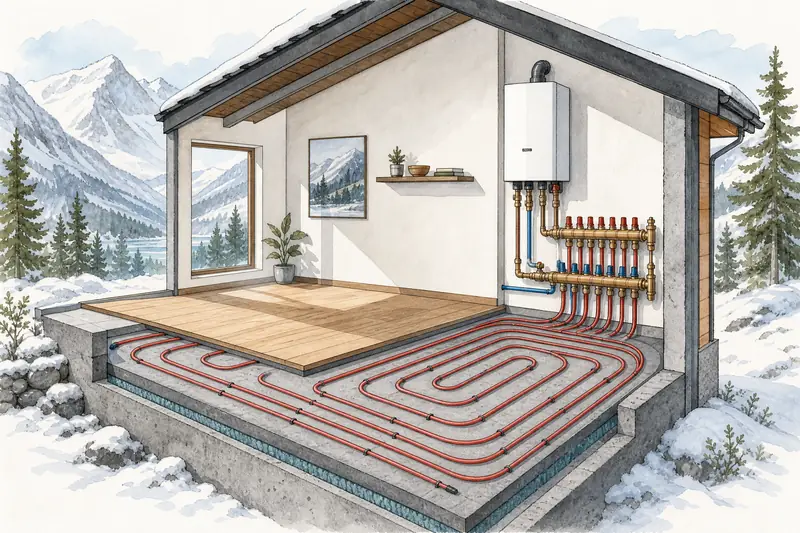
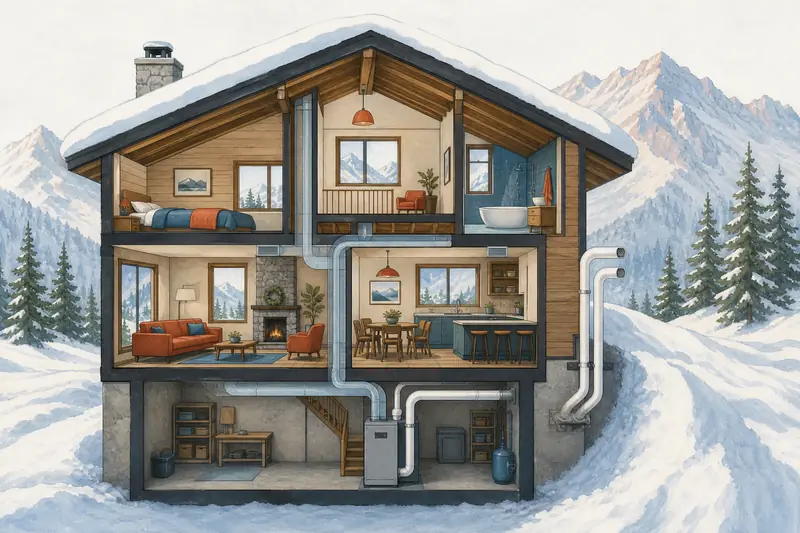
Boiler and water heater vents should end well above the deepest snow you expect, at whatever height the manual sets. Lochinvar's Knight manual says the air inlet "must terminate at least 12 inches above grade or snow line," and furnace makers Carrier, Lennox and Trane use the same 12-inch figure above anticipated snow.
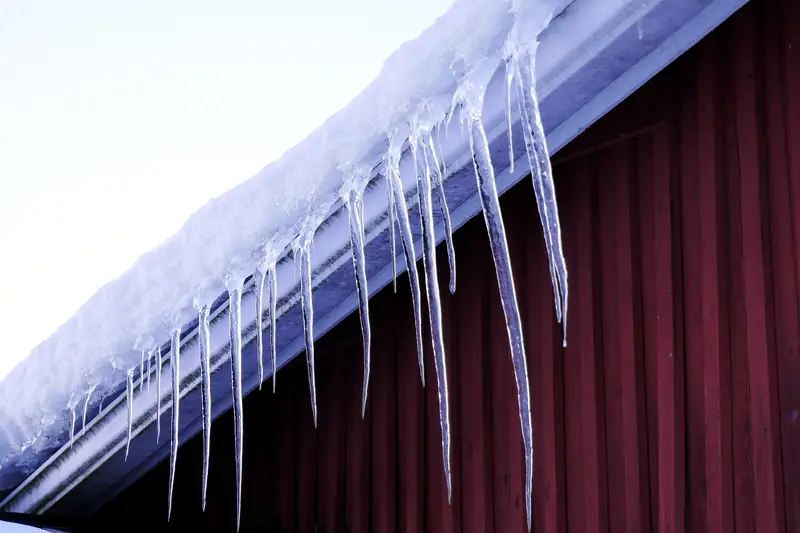
Up here, "snow line" means the February drift against your wall: the Aspen 1SW station averages about 170 inches of snow a year (NOAA 1991–2020 normals). Lochinvar also warns that condensate from the vent "can freeze, causing ice formations," and asks installers to place or guard the vent so it does not damage siding.
Vent length matters at altitude too, because it trims output further. Lochinvar notes the Knight's output "will reduce by up to 1.5% for each 25 feet of vent length." After a storm, clear snow from intake and exhaust pipes by hand or with a soft brush; Black Hills Energy asks customers to keep exhaust and air intake areas free of debris. If a vent keeps icing over or the boiler keeps locking out, call a qualified technician.
What should a replacement quote say about altitude?
A replacement quote should say how the new unit will be set for your elevation: the model, the kit or factory high-altitude version, the altitude band and the combustion readings to be recorded. If it is silent on altitude, ask before you sign.
It should also cover the paperwork. Glenwood Springs says on its building FAQ that replacing a water heater, furnace or boiler needs a permit and that gas piping work needs a licensed plumber; Aspen lists gas appliances and vents among its mechanical permit triggers. In Pitkin County, the Title 11 amendments require condensate from fuel-burning appliances to be neutralized before discharge, so a condensing unit there should come with a neutralizer.
A permitted fuel-fired appliance replacement also brings Colorado's 2009 carbon monoxide alarm law into play: the home needs an operational CO alarm within 15 feet of each bedroom entrance, and the CPSC suggests one on every level as well. Should an alarm go off or someone feel ill, move everyone into fresh air before calling 911. For a gas smell, get out, then call Black Hills Energy from outside; leave switches, phones and flames alone indoors.
Black Hills Energy's 2026 Colorado residential rebate form (read October 2026) lists $675 for a boiler at 90% AFUE, $1,000 at 95%, $900 or $1,500 for combination space and water heat at 90% or 95%, $400 for a tankless water heater at 0.87 UEF. Programs change; check before you buy. The utility rebates page has the rest.
To see what the equipment looks like before talking with installers, PlumbingSupplyAndMore's boiler category (part of Upvalley Heat's ownership group) shows the kind of boilers a qualified technician fits; the model, its altitude version and venting stay the installer's call.
Which upkeep matters most at altitude?
The upkeep that matters most at altitude is the yearly service visit, because combustion settings, vents and condensate drains all work harder in thin air and deep snow. Lochinvar says the Knight "should be inspected annually only by a qualified service technician," and its schedule includes cleaning and refilling the condensate trap, checking for gas, flue and condensate leaks, checking the expansion tank and inspecting the flame.
Between visits, Lochinvar's owner list is short: look at the boiler area and the pressure and temperature gauge, and check the vent and air pipes and their termination screens. Clearing snow from those terminations by hand is the main winter job.
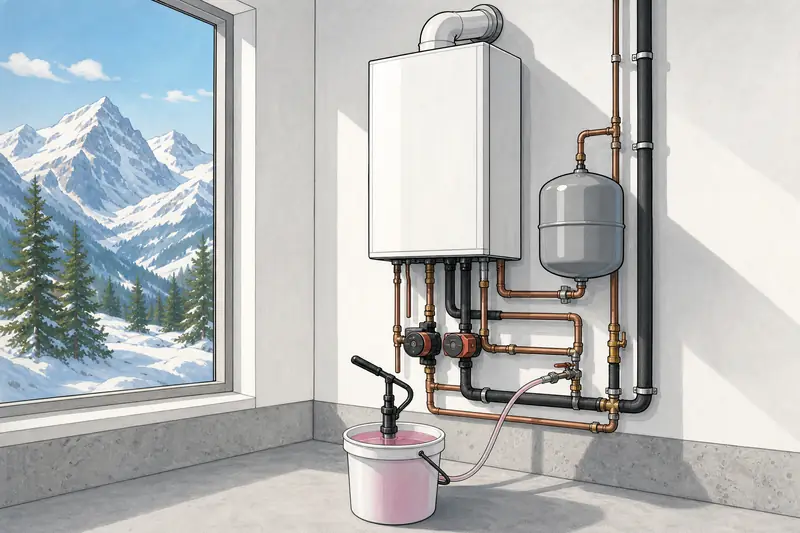
Water quality is the other altitude-country issue. The City of Aspen's water FAQ calls its water "very hard," at 130 to 300 ppm (8 to 17 grains per gallon), while Lochinvar's Knight wants boiler fill water below 7 grains and says to consult a local water treatment company above that. Fill water follows the boiler manual; ask your technician how your system was filled, and see boiler care and glycol for more.
Avalanche report: how this page was checked
This page is based on manufacturers' instructions opened in October 2026: Navien's NHB-H and NPE-2 high-altitude conversion instructions (no date shown), Weil-McLain's AquaBalance high-altitude addendum 550-100-319 (2017) and Lochinvar's Knight installation and operation manual (April 2010); furnace manuals for vent clearances; Black Hills Energy's 2026 rebate form; Glenwood Springs, Aspen and Pitkin County permit pages; Colorado's 2009 CO alarm law; the City of Aspen water FAQ; NOAA normals; and USGS elevations. Left out: altitude limits for A. O. Smith, Bradford White and other tank brands (no maker-hosted manual was found), Viessmann, any flow-rate figure at altitude, and any setting a homeowner could change.
Lift-line questions
Can I tell from the label whether my boiler is a high-altitude model?
Some makers mark it. Lochinvar fixes a high-altitude label to its factory high-altitude Knight boilers. For kit-converted units such as Navien's, the conversion paperwork and the installer's start-up record are the better proof, so ask for them.
My water heater says it is rated to 10,100 feet. Is it already set up?
Not necessarily. A rating to 10,100 feet means the unit can be converted to run there, and Navien still requires its kit above 5,400 feet plus the altitude menu setting. Only the installer's record shows whether that was done.
Does a longer vent run cost output at altitude?
It can. Lochinvar says the Knight's output drops by up to 1.5% for each 25 feet of vent length, on top of any altitude derate. Keeping the vent run short, within the manual's limits, is one of the installer's design choices.
Does a combi boiler lose hot water output at altitude?
Its gas input is derated for the whole appliance, so both heating and hot water come from a smaller firing rate. Weil-McLain's addendum applies the 4% per 1,000 feet rule to input on its AquaBalance combi. Ask the installer what hot water flow to expect at your elevation.
Should a condensing boiler's vent go through the roof to stay above snow?
The manual sets the allowed termination types and clearances, and sidewall vents are common. What matters is that the air inlet sits at least 12 inches above the expected snow line for a Knight, and that drifts and roof slides cannot bury it. The installer weighs that against vent length limits.
Does hard water matter for a boiler or only for the water heater?
Both. Boiler fill water should meet the maker's limits, such as Lochinvar's 7-grain ceiling, while a water heater or a combi's domestic side sees fresh hard water daily. Ask your technician about scale on both.
Keep going
Back to the base lodge: the Upvalley Heat home page and its six topics