Frozen Pipes: Prevent and Thaw Safely
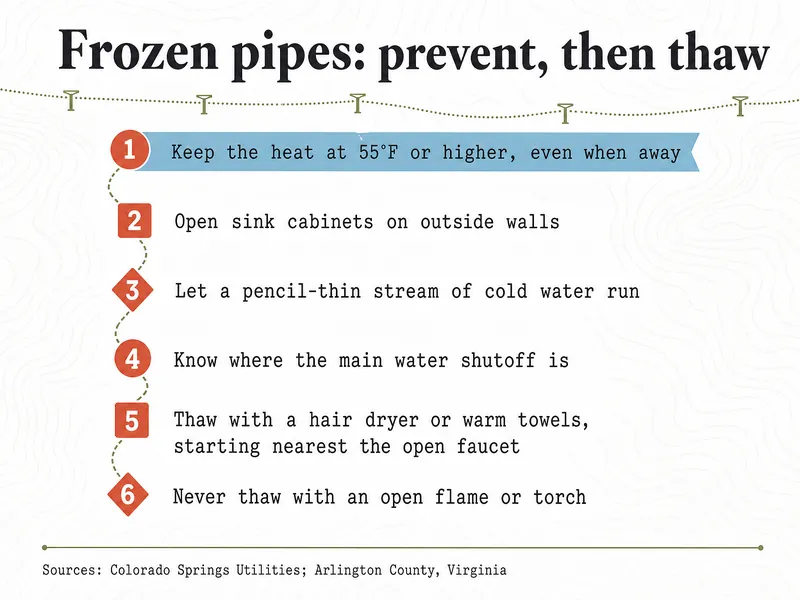
Frozen pipes are prevented by keeping the heat at 55°F or higher, opening cabinets on outside walls and letting a thin stream run; thaw slowly with a hair dryer or warm towels, never a flame.
Written by the Upvalley Heat desk from manuals and official pages · how figures are sourced · Rechecked
Ownership note: Upvalley Heat belongs to the same ownership group as PlumbingSupplyAndMore, Central Plumbing & HVAC, SoftPro Water Systems and Quality Water Treatment, the businesses this page links to. Figures here come from federal, Colorado, county and utility pages and from manufacturers' installation manuals, read in October 2026. What a store says about its own products is the store's claim, not a finding of this site. How partner links work here
First tracks
- Keep the thermostat at 55°F or higher, even when nobody is home, says Colorado Springs Utilities; switching the heat off invites burst lines.
- NOAA's 1991–2020 normals give the Aspen 1SW station about 14 nights a year at or below 0°F, against 6 at Glenwood Springs #2.
- Thaw a frozen pipe with a hair dryer, heating pad or warm towels, starting nearest the open faucet; Arlington County warns never to use a torch, kerosene heater or open flame.
- The CPSC's heat tape advice (1989): unplug and inspect it each fall, buy tape labeled for the pipe's size, and never wrap it over thermal insulation.
- Carrier's 59SC5A manual requires a condensate freeze protection kit wherever the furnace area can drop below 32°F; a technician fits it.
- Know where your main water shutoff is before the first cold snap, and mark it so you can find it in the dark.
How do you prevent frozen pipes in a mountain home?
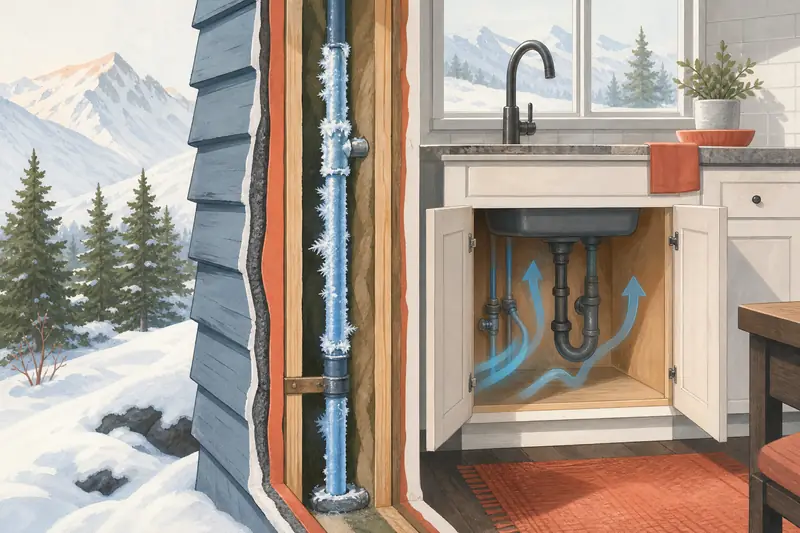
You prevent frozen pipes by keeping warm air around them: hold the heat at 55°F or higher, open sink cabinets on outside walls, and run a pencil-thin stream of cold water on the coldest nights. Colorado Springs Utilities, a Colorado municipal utility, gives all three steps and warns that turning the thermostat off "can lead to frozen or broken water pipes."
The steady trickle matters most on a faucet far from where water enters the house. Arlington County, Virginia, suggests opening the faucet farthest from the main valve to a small, steady trickle, and closing off crawl spaces, sealing drafty doors and insulating walls and attics so cold air never reaches the pipes.
Up here the season is long. NOAA's 1991–2020 normals for the Aspen 1SW station (about 8,175 feet) count roughly 210 days a year with a low at or below 32°F and about 14 nights at or below 0°F. Down-valley at Glenwood Springs #2 it is about 6 nights at or below zero. Either way, a frozen supply line is a question of when, not if, for a house left cold.
Freeze numbers for the valley
- 55°FLowest thermostat setting, even when awayColorado Springs Utilities
- 14Nights a year at or below 0°F, Aspen 1SW (1991–2020)NOAA NCEI
- 6Nights a year at or below 0°F, Glenwood Springs #2NOAA NCEI
- 32°FBelow this, Carrier requires a condensate freeze kitCarrier 59SC5A manual
Which pipes freeze first?
The pipes that freeze first are the ones closest to cold air: supply lines inside outside walls, under kitchen and bathroom sinks on exterior walls, and anything running through a crawl space, attic or unheated garage. Colorado Springs Utilities singles out cabinets "against an exterior wall," and Arlington County points to crawl spaces, drafty windows and doors, and thin wall and attic insulation.
Outside, the ground itself freezes deep. Garfield County's building code requirements sheet lists a frost depth of 36 inches up to 8,000 feet and 42 inches above 8,000 feet; that is a commercial code sheet, but it shows how far down the cold reaches. Hose bibs, sprinkler lines and any pipe near a vent or foundation crack are weak spots too.
| Spot | Why it freezes | What helps |
|---|---|---|
| Sink on an outside wall | Cabinet doors trap the pipe away from room heat | Open the cabinet doors on cold nights |
| Crawl space or unheated garage | Pipe sits in outdoor-temperature air | Close vents and openings; seal drafts |
| Supply line in an exterior wall | Thin insulation between pipe and siding | Insulate walls and attics; keep the heat at 55°F or more |
| Faucet farthest from the main | Water sits still in a long run | Let a pencil-thin cold stream run |
| Condensate drain of a high-efficiency furnace | Water drains through a cold space | A technician fits a freeze protection kit |
How do you thaw frozen pipes safely?
Thaw a frozen pipe slowly with gentle heat: a hair dryer, a heating pad or warm towels, working from the faucet end back toward the frozen spot with the faucet open. Colorado Springs Utilities says to start "nearest to the faucet" so melted water can drip out, and not to use a hair dryer around standing water.
Never use a torch, kerosene heater or any open flame, and keep heat away from anything that can burn (Arlington County). Arlington also says not to thaw a water meter yourself.
If a pipe has already split, shut the water off at the main valve right away. Arlington suggests marking that valve with fluorescent paint or tape so you can find it in the dark. When the pipe is inside a wall you cannot reach, or the thaw does not bring water back, call a licensed plumber.
Is heat tape safe for frozen pipes?
Heat tape is safe only when it is the right product for that pipe and is used exactly as its maker says. In a 1989 safety release the CPSC, the federal product safety agency, told owners to unplug heat tape each fall and check its whole length for cracked or charred insulation and bare wires, replacing it if any turn up.
The same release says to buy tape labeled for the pipe's diameter and length, not to lap tape over itself unless the instructions allow it, and not to wrap it over thermal insulation. If insulation goes over the tape, the CPSC says it must be non-flammable, such as fiberglass, and only where the maker recommends it. Owners unsure about checking tape under a house can hand the job to a licensed electrician.
Outdoor heat tape also costs money up front in two jurisdictions: under the REMP exterior energy rules, Aspen charges $3.26 per watt and Pitkin County $3.39 per watt.
Can a furnace condensate line freeze?
Yes. A high-efficiency (condensing) furnace makes water as it burns gas, and that water drains through a trap and a plastic line that can freeze if it passes through a cold crawl space, garage or outside wall. Carrier's 59SC5A installation manual says that where the temperature may fall below 32°F a condensate freeze protection kit, a trap with a heat pad, is required, and it allows only self-regulating, shielded, waterproof heat tape rated 3 to 6 watts per foot on the rest of the drain line.
A frozen drain backs water up, and that alone can shut a furnace down. That is why a cold house with a no-heat problem is worth checking for ice at the drain. Where the furnace sits below the nearest floor drain, a condensate pump lifts the water out; the pump, its discharge line and any freeze kit are a technician's job to fit and route. PlumbingSupplyAndMore's condensate pumps (part of Upvalley Heat's ownership group) show what these parts look like. If you are unsure, stop and call a qualified technician.
What should a second-home owner set up?
A second home needs heat that stays on, water that can be shut off, and someone who checks the house after storms. Colorado Springs Utilities says to keep the thermostat at 55°F and turn off the indoor water supply at the valve when you leave; Arlington County adds that a home with a boiler or other wet heating system left vacant should be set up by a licensed plumber.
Snow is the other risk. After a big storm, both plastic pipes of a high-efficiency furnace need to be clear: makers set them a foot or more clear of the snow they expect, and a drift can shut the furnace down (see snow-blocked vents). Ask whoever checks the house to look at the vents and the thermostat reading on each visit.
A furnace or boiler that stops in a power cut leaves pipes exposed too; the winter power outage page covers that. For the wider picture of cold-weather risks, start from the cold snaps overview.
Avalanche report: how this page was checked
This page is based on Colorado Springs Utilities' frozen lines page and Arlington County, Virginia's frozen pipes page (both read October 2026); the CPSC heat tape release of September 1989; Carrier's 59SC5A installation manual (edition January 2019); NOAA NCEI 1991–2020 climate normals for Aspen 1SW and Glenwood Springs #2; and Garfield County's commercial building code requirements sheet (updated July 2023). Left out: the CPSC's 1989 heat tape fire count, which is decades old; any figure for how fast a pipe freezes, which no source gives; and local utility rules on who owns a service line, which were not checked for the valley's towns.
Lift-line questions
Should you leave the heat on in a vacant mountain cabin?
Yes. Colorado Springs Utilities says to set the thermostat at 55°F rather than turn it off, because an unheated house can freeze and break pipes. Also turn off the indoor water supply at the valve before you leave.
Hot or cold water: which tap should drip?
Colorado Springs Utilities says to run a continuous stream of cold water about the width of a pencil. Arlington County suggests using the faucet farthest from the main valve.
Can you use a space heater to thaw a pipe under a sink?
A space heater needs at least 3 feet of clear space from anything that can burn, which is hard to keep inside a cabinet. A hair dryer, heating pad or warm towels are the gentler methods the county and utility pages name.
Why did only the kitchen pipe freeze?
Pipes in a cabinet on an outside wall sit in the coldest air in the room, which is why Colorado Springs Utilities says to open those cabinet doors on extra cold days.
Is it safe to thaw a frozen water meter?
Arlington County says not to thaw a water meter yourself. Ask your water provider.
Does heat tape need its own inspection each year?
The CPSC says to unplug it and inspect its full length each fall, and to replace it if the insulation is cracked or charred or wires show.
Who protects a furnace condensate line from freezing?
The furnace installer. Carrier's manual calls for a freeze protection kit wherever the furnace area can fall below 32°F.
More on cold snaps
Back to the base lodge: the valley elevation profile and topic list